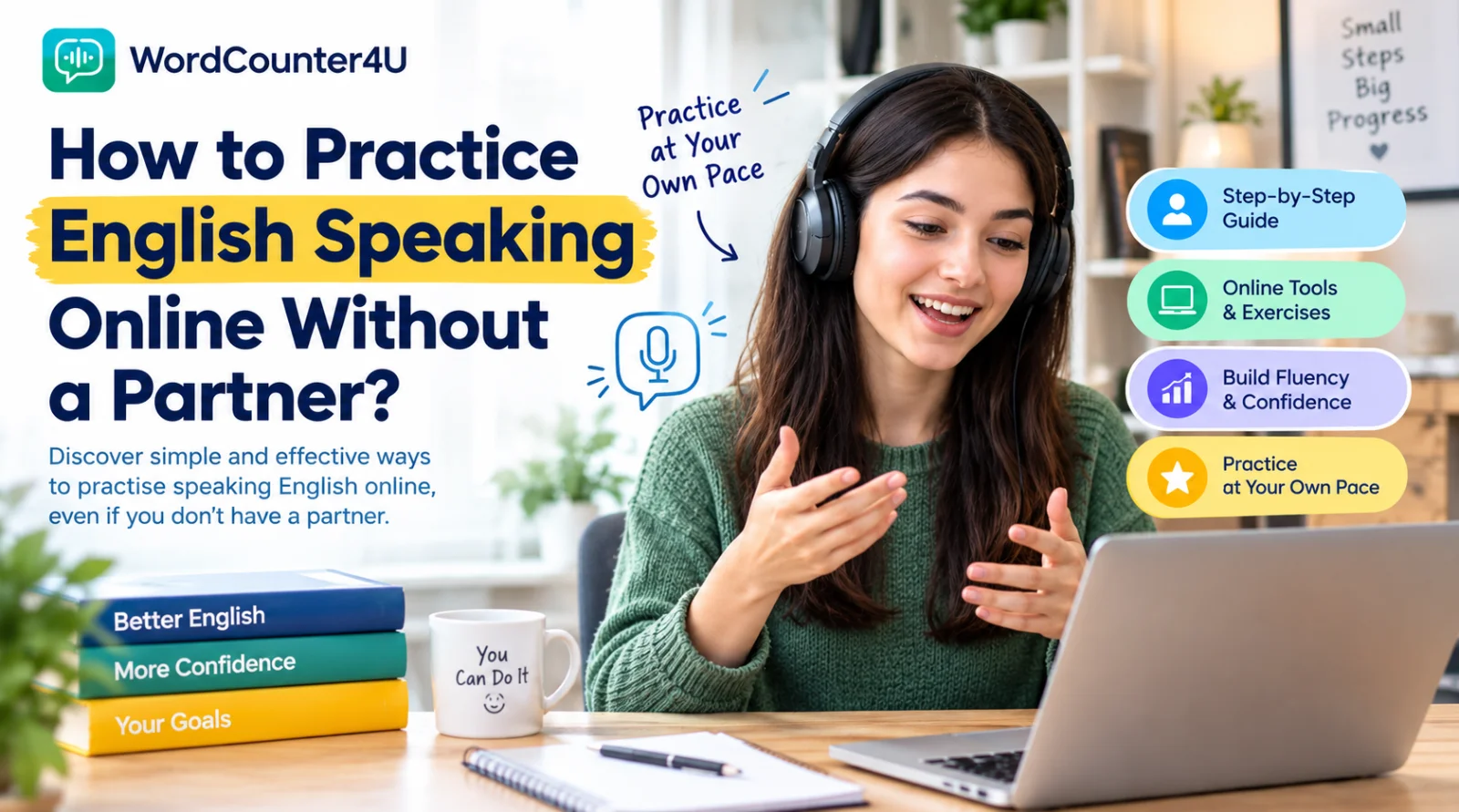
How to Practice English Speaking Online Without a Partner?
Learn practical ways to practise English speaking online without a partner, including solo speaking exercises, prompts, read-aloud practice, role-plays, and a simple 15-minute routine.
On this page10 sections
How to Practice English Speaking Online Without a Partner
You can practise English speaking online even when you do not have a conversation partner. The key is to replace an unstructured “I should speak more” goal with specific speaking activities: read aloud, answer prompts, describe what you see, retell information, practise short role-plays, and review your delivery. A speaking tool can add structure and measurable feedback when you want it.
Can You Practise English Speaking Without a Partner?
Yes. A partner is useful for real-time interaction, but it is not required for every kind of speaking practice. When you practise alone, you can work deliberately on producing sentences, retrieving vocabulary, maintaining a steady pace, reading aloud, and becoming more comfortable hearing your own English.
The important distinction is that solo practice does not reproduce everything that happens in a conversation. A conversation requires listening to another person, taking turns, reacting to unexpected answers, asking follow-up questions, and adjusting what you say in real time. Solo practice is therefore best treated as one part of a wider English-learning routine rather than a complete replacement for interaction.
Why Practise English Speaking Online by Yourself?
Practising alone removes several common barriers. You do not have to wait for a class, coordinate schedules, or find someone who is available at the same level. You can also repeat the same exercise immediately if a sentence causes difficulty.
· You can practise at a time that suits you.
· You can repeat an exercise without worrying about slowing another learner down.
· You can choose material that matches your current level.
· You can focus on one skill at a time, such as pace, clarity, vocabulary retrieval, or delivery.
· You can build a short routine that is easier to repeat consistently.
For many learners, the biggest advantage is simply getting more opportunities to speak aloud. Even a short session can be useful when it has a clear purpose.
7 Ways to Practise English Speaking Online Without a Partner
1. Read English Texts Aloud
Reading aloud is one of the simplest forms of solo speaking practice. Choose a short passage that you understand reasonably well and read it aloud rather than silently.
Start with a paragraph or a short script. Concentrate on completing each sentence, keeping a comfortable pace, and noticing where you naturally pause. Once the material feels easy, move to a longer or slightly more demanding passage.
Reading aloud is especially useful when you are still getting comfortable producing English sounds and complete sentences without stopping after every few words.
2. Answer Speaking Prompts Out Loud
A prompt gives you a reason to speak instead of leaving you wondering what to say. Use simple questions at first, then gradually choose topics that require longer answers.
· What did you do yesterday?
· What is one skill you would like to learn?
· Describe your usual morning.
· What makes a good workplace?
· Would you rather live in a big city or a small town? Why?
Give yourself 30 seconds to think, then answer aloud for one or two minutes. Do not try to write the perfect answer before speaking. The purpose is to practise turning ideas into spoken English.
3. Describe What You See Around You
Look around your room, workplace, street, or another familiar place and describe what you see. This activity is useful because the subject is already in front of you, so you do not need to invent a complicated topic.
For example, instead of naming objects one by one, build connected sentences: “There is a desk near the window. I usually keep my laptop here, and I use the space in the evening when I need to work without interruptions.” As your confidence improves, add reasons, comparisons, details, and opinions.
4. Retell Something You Read or Watched
Read a short article, watch a short English video, or listen to a brief piece of content. Then close it and explain the main idea in your own words.
This is more demanding than reading aloud because you have to retrieve information and build your own sentences. If you get stuck, do not immediately switch to your first language. Try a simpler English sentence that communicates the same idea.
A useful progression is: first give a 30-second summary, then a one-minute summary, and eventually explain the topic with an example or your own opinion.
5. Practise Both Sides of a Short Role-Play
You can simulate a conversation even when nobody else is available. Choose a realistic situation and speak both parts out loud. For example, practise asking a colleague for help, ordering something, introducing yourself, or discussing a simple workplace problem.
Say the first line, pause, imagine the response, and then answer it. Change your tone or position slightly between the two roles so the activity feels like an exchange rather than a memorised paragraph.
This does not fully recreate spontaneous conversation, but it can help you rehearse useful language before you need to use it with another person.
6. Record Yourself and Review the Result
If you have a way to record your voice, choose a short topic and speak for one or two minutes. Listen back and note specific things you want to improve.
· Where did you pause for a long time?
· Which words or phrases were difficult to say?
· Did you repeat the same word too often?
· Did you speak so quickly that some words became unclear?
· Could you explain the same idea more simply?
The goal is not to criticise every mistake. Pick one or two observations and use them in your next attempt. That turns recording into a learning activity instead of simply creating more recordings.
7. Use a Structured Online Speaking Practice Tool
A speaking practice tool can be useful when you want ready-made material, a defined practice session, and feedback after you speak. It is particularly helpful when the hardest part of practising alone is deciding what to practise.
For example, WordCounter4U's Speaking Challenge uses a teleprompter-style script for read-aloud practice. The current tool offers scripts from A1 to C2, different durations, and Practice Mode without a countdown. It can show words per minute, accuracy, completion, and a word-by-word review after a session.
How to Build a 15-Minute Solo Speaking Session
You do not need a long study session to create a useful speaking habit. A simple 15-minute routine can give each part of the session a clear purpose.
1. 2 minutes — Warm up. Introduce yourself or describe what you are doing today.
2. 4 minutes — Read aloud. Choose a short English passage and concentrate on clear delivery.
3. 4 minutes — Speak freely. Answer one prompt, describe something, or retell information without reading a script.
4. 3 minutes — Review. Identify one recurring difficulty, such as pauses, unclear words, or vocabulary gaps.
5. 2 minutes — Repeat. Speak about the same topic again and deliberately work on the one issue you identified.
The second attempt matters. Comparing two short attempts can show whether a specific change helped more clearly than simply practising once and moving on.
How to Choose the Right Difficulty
Solo speaking becomes frustrating when the material is far above your current level. It can also become unproductive when everything is so easy that you never have to retrieve new language.
· If you understand the topic but hesitate over individual words, keep the topic and simplify the language.
· If you cannot understand most of the material, choose an easier passage before trying to speak it.
· If you can speak comfortably but rely on the same simple sentences, introduce a more specific topic or a longer response.
· When a passage becomes comfortable, increase the difficulty gradually rather than making a large jump.
For structured read-aloud practice, CEFR levels can provide a useful starting point. WordCounter4U's Speaking Challenge currently provides A1 through C2 scripts, so learners can choose material that broadly matches their level.
Solo Speaking Practice vs Conversation Practice
It helps to be clear about what each type of practice can and cannot do.
| Practice type | Useful for | What it does not fully provide |
|---|---|---|
| Reading aloud | Pace, delivery, confidence, sentence flow | Spontaneous interaction |
| Solo prompts | Vocabulary retrieval and forming answers | Real-time turn-taking |
| Role-play alone | Rehearsing common situations | Unpredictable responses |
| Speaking with a partner | Interaction, listening, turn-taking | Private repetition on your own schedule |
The practical answer is not to choose only one. Use solo practice to increase the amount of speaking you can do independently, then add real conversations when you want to practise listening, reacting, and interacting with another person.
Common Mistakes When Practising English Alone
Trying to speak as fast as possible
Fast speech is not automatically good speech. If you rush, clarity can suffer and you may lose accuracy. Use speed as one measurement, not the sole goal.
Writing everything before you speak
A complete script can make speaking feel easier, but it also removes much of the retrieval work. Mix prepared read-aloud practice with activities where you have to form your own sentences.
Choosing material that is too difficult
If nearly every sentence contains unfamiliar vocabulary or complicated structures, you may spend more time decoding the material than practising speaking.
Practising once and expecting a major change
A short routine that you can repeat is generally more useful than an occasional session that is difficult to maintain.
Treating a score as the whole picture
Measurements such as words per minute, accuracy, and completion can help you notice patterns, but they do not describe every part of speaking ability. Use them alongside your own review of clarity, vocabulary, pauses, and comfort.
How to Measure Progress When You Practise Alone
Keep a simple record of a few things rather than trying to measure everything.
· How long you can speak before getting stuck.
· How often you pause or restart a sentence.
· Words and phrases you repeatedly struggle to retrieve.
· Whether your delivery becomes clearer at a comfortable pace.
· The difficulty and length of material you can handle.
· Your results on repeatable speaking exercises.
If you use WordCounter4U's Speaking Challenge, the session result includes words per minute, accuracy, completion, and a word-by-word review. Those measurements can give you concrete points to examine between attempts.
When an Online Speaking Practice Tool Can Help
An online tool is most useful when you want structure without needing another person. Instead of spending part of every session deciding what to do, you can choose a suitable exercise, speak, review the result, and repeat.
If you want to continue with structured read-aloud practice,
open the WordCounter4U Speaking Challenge and choose a script that matches your level. If your goal is conversational ability, combine this kind of solo work with opportunities to listen and respond to other people.
Conclusion
You do not need a speaking partner every time you want to practise English. Reading aloud, answering prompts, describing your surroundings, retelling information, role-playing, recording yourself, and using a structured speaking tool can all create useful opportunities to speak.
The best solo routine is one you can repeat. Start with material you understand, speak aloud instead of practising only silently, review one or two specific points, and repeat the activity. Then add real conversations when you want to develop the listening and interaction skills that solo practice cannot fully reproduce.
Was this guide useful?
Your vote is anonymous and helps us decide what to write next.
Frequently asked questions
Can I really improve my English speaking without a partner?
Yes. Solo activities such as reading aloud, answering prompts, describing things, retelling information, and practising role-plays can give you regular opportunities to speak. A partner is still useful for interaction and spontaneous conversation.
How can I practise speaking English online for free?
You can use free online speaking materials, read English passages aloud, answer prompts, practise short role-plays, or use a free speaking practice tool. The important part is having a specific activity rather than simply reading about English.
What should I talk about when practising English alone?
Use familiar subjects first: your daily routine, work, studies, hobbies, plans, travel, family, or something you recently watched or read. As you become more comfortable, move to topics that require explanations, comparisons, and opinions.
How long should I practise English speaking each day?
There is no single amount that suits every learner. A short session that you can repeat consistently is a practical starting point. A 10- to 15-minute routine can be enough to create a regular speaking habit.
Is speaking alone the same as conversation practice?
No. Speaking alone helps with production, delivery, retrieval, and confidence, but it does not fully reproduce listening, turn-taking, spontaneous responses, or interaction with another person.
Can I use a speaking practice tool without a partner?
Yes. A structured tool can provide the material and feedback while you practise independently. WordCounter4U's Speaking Challenge is designed for read-aloud practice and provides session measurements such as WPM, accuracy, completion, and word-by-word review.