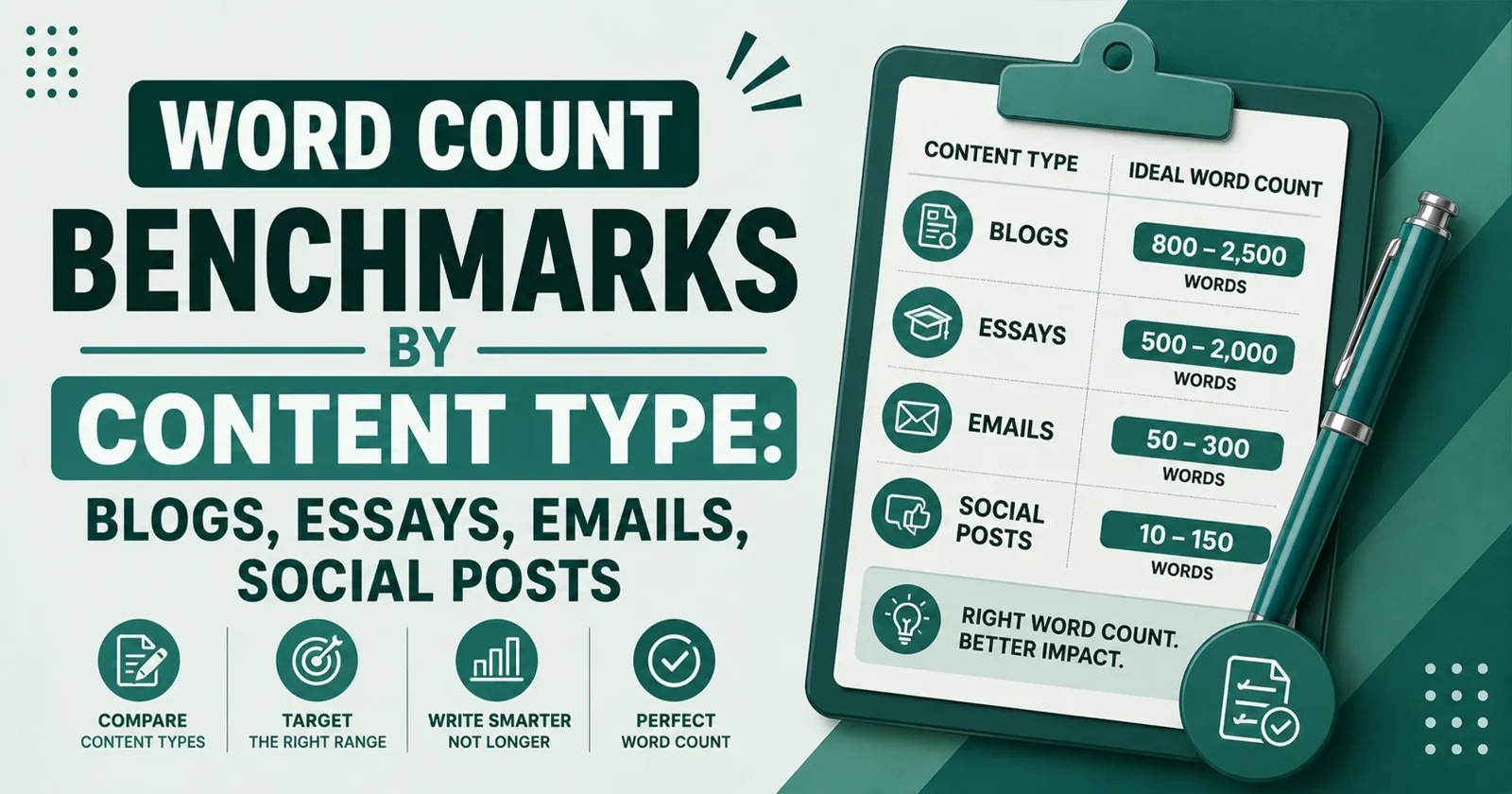
Word Count Benchmarks by Content Type: Blogs, Essays, Emails, Social Posts
There's no single "right" word count — a blog post, an essay, an email, and a social caption all have different ideal lengths. Here are the real benchmarks for each, and why.
On this page4 sections
"How long should this actually be?" is one of the most common questions writers ask, and it rarely has a single honest answer. A word count that works well for a blog post would look wildly excessive in an email. A word count that's completely normal for an academic essay would read as slow and padded on social media. Even within a single content type — "a blog post," "an email," "a social caption" — the real benchmark shifts depending on the specific sub-type and what the writing is trying to accomplish.
This guide breaks down realistic word count ranges across the four content types writers deal with most: blog posts, academic essays, professional emails, and social media captions. Each section covers the sub-types within that category, the reasoning behind the benchmark, and a reference table you can check your own draft against.
Blog posts
Blog content is probably the category where writers get the most conflicting advice about length, and a lot of that comes from treating "blog post" as one single format when it's actually several different ones with very different jobs to do.
The widely cited range for blog content aimed at ranking in search is somewhere between 1,000 and 2,500 words for competitive topics. That range didn't come from nowhere — it reflects a real pattern in how search engines and readers both respond to content depth. Longer, well-organized posts tend to cover a topic more completely, answer more of the reader's likely follow-up questions within the same page, and naturally attract more internal links from other pages on the same site and more external links from other sites referencing the content. None of that happens because search engines directly reward length. It happens because length, when it's earned rather than padded, is usually a signal of thoroughness.
But "1,000–2,500 words" is a range for competitive, comprehensive blog content — not a rule that applies evenly across every kind of post. A few real distinctions matter here:
Search intent changes the target more than anything else. A query like "how many words is a five-minute speech" has a short, direct, factual answer. Padding that answer out to 2,000 words to hit a target usually makes the post worse, not better, because the reader has to dig through filler to find the one number they came for. A query like "how to start a small business" carries much broader intent — the reader genuinely wants (and search engines expect) a comprehensive answer covering multiple sub-topics, which naturally pushes the useful length up toward 2,500–3,500 words or more.
Content format changes the target. A listicle post ("10 tools for X") can hit its natural length once each item has a genuinely useful description — padding beyond that just dilutes the list. A "complete guide" or pillar-style post is expected to be comprehensive by definition, and readers arriving at that kind of title are specifically looking for depth, not a quick answer.
Niche and competition level change the target. In heavily contested niches — personal finance, health, software comparisons — the existing top-ranking content is often already extremely thorough, and a shorter post has to work much harder (through unique data, original examples, or a genuinely different angle) to compete. In smaller or less competitive niches, a well-targeted 800-word post can rank perfectly well because there's simply less competing depth to beat.
Update frequency and freshness also interact with length. A post that's kept current — updated as facts change, expanded as new sub-questions emerge from real reader behavior — often ends up naturally longer over time than a post written once and left alone, and that organic growth tends to read as more authoritative than an artificially long first draft.
| Blog post format | Typical word count | Reasoning |
|---|---|---|
| Direct/factual answer post | 500–900 words | Reader wants one clear answer; padding hurts more than it helps |
| Standard how-to or explainer | 1,000–1,800 words | Enough room to cover the process fully, plus context and caveats |
| Listicle ("X tools/tips/ideas for Y") | 1,200–2,000 words | Depends on item count; each item needs a genuinely useful description, not a one-liner |
| Comparison or "vs" post | 1,500–2,500 words | Needs to cover both sides fairly with enough detail to actually help a decision |
| Complete guide / pillar content | 2,500–4,000+ words | Expected to be comprehensive by the reader; often the anchor page for a topic cluster |
| News or timely update post | 400–800 words | Speed and clarity matter more than exhaustive coverage |
| Product/service page-style post | 800–1,500 words | Enough to build trust and answer objections without becoming a wall of text |
The practical approach for any blog post: write to fully answer the specific query and search intent behind the title, then check where you landed. If you're at 600 words and the topic clearly needs more depth to be genuinely useful, expand with real substance — new sub-questions, examples, data — not repetition. If you're at 3,000 words and could say the same thing in 1,200 without losing anything a reader needs, that's a sign to trim, not a sign you've done more work.
Academic essays
Academic writing works on fundamentally different logic than blog content. Where a blog post's length is guided by what the topic and search intent require, an academic assignment almost always comes with a specific word count attached from the start — and it's rarely just a friendly suggestion. Going significantly under a professor's word count typically signals underdeveloped analysis or insufficient engagement with the material. Going significantly over often gets penalized directly, either through a grading deduction or because anything past the cutoff simply won't be read or counted.
What makes this category harder to give one benchmark for is how much the "typical" range varies by assignment type, academic level, and institution. A high school reflection paper, an undergraduate research essay, and a doctoral dissertation chapter are all "academic writing," but they operate at completely different scales, and the word count logic behind each is different too.
Short-form academic writing — reflections, response papers, discussion posts — tends to run 250–500 words. The goal here isn't comprehensive coverage; it's demonstrating that you engaged with a specific idea or reading in a focused way. Padding a 300-word reflection to 600 words usually just dilutes the one insight that was worth making.
Standard essays, the most common undergraduate assignment type, typically run 1,000–1,500 words. This is enough room to state a thesis, develop two or three supporting points with real analysis (not just summary), address a counterargument, and reach a conclusion — without so much room that the argument gets padded with repetition or excessive quotation.
Application essays, like the Common App personal statement, are a special case: they carry a hard, non-negotiable limit (650 words for the Common App) specifically because admissions readers are evaluating thousands of essays and need writers who can make a genuine impression concisely. Here, going under the limit by a lot is often worse than writing right up to it, since it can look like the writer didn't have enough to say.
Research papers at the undergraduate level typically run 2,000–5,000 words, scaling with the complexity of the argument and the amount of source material being synthesized, not just described.
Extended essays and IB-style assessments often carry very specific hard caps (4,000 words for the IB Extended Essay, for example) that are enforced strictly, sometimes with penalties for essays that exceed the limit even by a small margin.
Dissertations and theses are the outlier on this list by a wide margin. A single dissertation chapter often runs 6,000–12,000 words, and a complete dissertation or thesis can range anywhere from roughly 15,000 words for some master's-level work up to 50,000 words or more for doctoral theses in certain fields — with enormous variation by discipline, institution, and country. A literature review chapter, a methodology chapter, and a results chapter within the same dissertation often have meaningfully different natural lengths too, since each is doing a different kind of intellectual work.
One detail that trips up a lot of students: many academic word counts explicitly exclude certain sections — references/bibliography, footnotes, appendices, and sometimes the abstract — from the official count. Always check the specific instructions rather than assuming your word processor's total count is the number that matters, since submitting an essay that looks compliant by your own count but isn't by the assignment's actual counting rules is a completely avoidable mistake.
| Assignment type | Typical word count | Notes |
|---|---|---|
| Short response / reflection | 250–500 words | Focused engagement with one idea, not broad coverage |
| Standard undergraduate essay | 1,000–1,500 words | Thesis, 2–3 developed points, counterargument, conclusion |
| Common App personal statement | 650 words (hard limit) | Going well under the limit can look like a missed opportunity |
| IB Extended Essay | 4,000 words (hard limit, strictly enforced) | Often penalized for exceeding, even slightly |
| Undergraduate research paper | 2,000–5,000 words | Scales with source complexity and argument depth |
| Master's thesis | 15,000–25,000 words (varies by field) | Institution- and discipline-specific |
| Dissertation chapter | 6,000–12,000 words | Varies by chapter type (literature review vs. methodology vs. results) |
| Full doctoral dissertation | 30,000–50,000+ words | Enormous variation by field and country |
Because academic word counts are assigned rather than optimized, the most useful habit here isn't finding an "ideal" — it's checking your actual count well before a deadline, confirming exactly what does and doesn't count toward the total, and treating the number as a real constraint to plan around rather than something to sort out in a rush at the end.
Professional emails
Email is the format where excess length hurts fastest and most visibly. Most professional readers skim rather than read in full, especially past the first couple of sentences, and inbox behavior consistently shows that shorter, clearer emails get read more completely and get faster responses than longer ones covering the same ground. But "keep every email short" is too blunt a rule on its own — the right length still depends heavily on what kind of email it is and what relationship exists between sender and reader.
Quick updates and FYIs are the shortest category, typically 50–100 words. The reader just needs the fact or status; anything beyond that is unnecessary framing.
Standard requests — asking a colleague for something, requesting a document, scheduling a call — work best around 100–150 words: enough room for brief context plus a single, clearly stated ask, without burying that ask under paragraphs of preamble.
Cold outreach emails have a narrower sweet spot than people often assume. Because the recipient has no existing relationship or context, a cold email needs just enough setup to establish relevance and credibility — but long cold emails get abandoned before the reader even reaches the actual ask. 100–150 words is a realistic target; anything much longer meaningfully reduces response rates in most professional contexts.
Follow-up emails should generally be shorter than the original message, not longer. Since the context already exists in the previous email or the reader's memory, a follow-up that restates everything from scratch tends to feel repetitive and kills momentum rather than rebuilding it. 50–75 words is usually enough for a follow-up that references the earlier message and adds only what's changed or a gentle nudge.
Customer support replies need enough room to actually resolve the issue — cutting a support email down to an artificially short length at the expense of clarity just generates a second email asking for clarification. 100–200 words is a reasonable range, with an emphasis on directly answering the question early rather than opening with lengthy apology or boilerplate.
Internal team updates and status reports can run longer, typically 150–300 words, since the reader has effectively opted into more detail by requesting or expecting a regular update. Even here, structure (short paragraphs, bullet points, a clear "what changed" section) matters more than strict brevity.
Newsletters are the longest standard email category, often 300–600 words, because subscribers have opted in expecting more substantive content. Even at this length, the same skimming behavior applies — readers scan for the parts relevant to them, so clear subheadings and short paragraphs matter as much as the total count.
| Email type | Typical word count | Why |
|---|---|---|
| Quick update / FYI | 50–100 words | Reader just needs the fact, not the context |
| Standard request or ask | 100–150 words | Enough room for context + a clear, single ask |
| Cold outreach | 100–150 words | Long cold emails get abandoned before the ask is reached |
| Follow-up email | 50–75 words | The original context already exists; restating it kills momentum |
| Customer support reply | 100–200 words | Needs to fully resolve the issue, without unnecessary padding |
| Internal team update / status report | 150–300 words | Slightly more room since the reader has opted into detail |
| Newsletter | 300–600 words | Readers expect more substance, but still skim — structure matters as much as length |
Across every category, one rule holds regardless of the target word count: the ask or main point should appear within the first two sentences. If a reader has to scroll or hunt to find out what you actually need from them, the email is too long for what it's trying to do — independent of its total word count. When an email is running noticeably over its type's benchmark, that's usually a sign it should either be split into a shorter email plus an attached document for the supporting detail, or trimmed down to just the decision or ask, with the rest available if the reader wants it.
Social media captions
Social content is the category where "ideal length" varies most by platform, because each platform has different display rules, different audience expectations, and a different relationship between caption length and how the algorithm actually distributes the post. A caption that performs well on LinkedIn would look strange and out of place on X, and a caption written for X's constraints would waste the room LinkedIn's audience actually expects to be filled.
Instagram captions get visually truncated after roughly the first two lines (around 125 characters) before a "more" link appears, which means the opening line is doing almost all the work of earning a tap-through. The platform technically allows captions up to 2,200 characters, and longer, storytelling-style captions can absolutely work — but only when that first line is strong enough to justify the click, since most viewers never expand a caption that doesn't hook them immediately.
X (Twitter) has a hard 280-character limit, but the data on what actually performs well sits well under that ceiling. Most high-engagement posts run closer to 70–100 characters — short enough to be grasped instantly while scrolling, with enough room left for a reply or quote-post to add to the post without hitting the character wall themselves.
Facebook posts follow a similar pattern to Instagram in that shorter consistently outperforms longer: posts under roughly 80 words tend to see meaningfully higher engagement than longer-form captions, likely because the platform's feed algorithm and scrolling behavior reward content that can be absorbed in a glance.
LinkedIn is the clear exception to "shorter is always better." Because the platform's audience explicitly expects more professional, substantive content, posts in the 100–200 word range — broken into short paragraphs and single-line breaks rather than dense blocks — regularly outperform much shorter posts. LinkedIn's own display behavior also encourages this: longer posts get truncated behind a "see more" link at a certain point, and posts that earn that click tend to get rewarded with more visibility by the platform's distribution.
TikTok and Instagram Reels captions function differently again, since the video itself is the primary content and the caption is closer to a supporting hook or piece of context. Captions under roughly 150 characters tend to work best — enough for a hook, a question, or a single piece of context, without competing with the video for attention.
Pinterest pin descriptions are a genuine outlier: because Pinterest functions partly as a visual search engine rather than a purely social feed, descriptions benefit from being keyword-rich within a 100–200 character range, prioritizing discoverability over pure engagement copy.
| Platform | Character/word benchmark | Notes |
|---|---|---|
| Instagram caption | Under 125 characters shown before "more" | Up to 2,200 characters allowed; longer captions work only if the first line earns the tap |
| X / Twitter post | 280 characters (hard limit) | Highest-performing posts often run 70–100 characters |
| Facebook post | Under 80 words | Shorter posts consistently outperform long-form captions |
| LinkedIn post | 100–200 words (short paragraphs) | The clear exception — the audience expects substance, not brevity |
| TikTok / Reels caption | Under 150 characters | Caption supports the video; keep it as a hook or context line |
| Pinterest pin description | 100–200 characters | Keyword-rich, since Pinterest doubles as a search engine |
The common thread across every platform, despite the very different numbers, is the same: assume the reader is deciding within the first line whether to keep reading, watching, or scrolling past — and write that first line to earn everything after it.
Why "ideal" word count is really a floor, not a target
Across every content type covered above, the benchmark is best treated as a realistic range to check your instincts against — not a number to write toward artificially. A 1,400-word blog post that thoroughly answers the reader's question beats a 2,200-word post that repeats itself to hit a target length. A 180-word email that says exactly what's needed beats a 90-word email that leaves out a detail the reader actually needed to act. A 1,200-word essay that develops its argument fully beats a 1,500-word essay padded with restated topic sentences and unnecessary quotation.
The benchmarks matter most as a sanity check in both directions. If you're dramatically under the typical range for what you're writing, it's worth asking whether you've actually covered what the piece needs to cover — a suspiciously short blog post on a broad topic, or a research paper well under its assigned length, is often a sign of underdeveloped content rather than efficient writing. If you're dramatically over, it's worth asking whether every section is still earning its place, or whether some of that length is coming from repetition, hedging, or explaining the same point multiple ways instead of once, clearly.
Checking your count as you write
Whichever content type you're working in, the easiest way to stay aware of where you stand relative to these benchmarks is to check your live word count as you go, rather than only once you think a draft is finished. A word counter tool that updates instantly as you type or paste text means you're never guessing whether a draft "feels" long enough or short enough for its type — you can see the actual number next to the benchmark you're aiming for, whether that's a blog post, an essay section, an email, or a caption with a hard character cap.
This matters even more when you're moving between formats in the same day — drafting a blog post in the morning, a batch of cold outreach emails at midday, and social captions to promote the post in the afternoon — since the target length changes completely between each one, and it's easy to lose track of which range applies to what you're currently writing. If you also want to check reading time or keyword density on the same draft, it's worth browsing the full set of writing tools rather than switching between separate sites for each check.
If you're working against a strict, non-negotiable limit rather than a general benchmark — a college application essay, a meta description, a character-capped bio — our guide on how to write to a strict word limit without losing meaning covers the actual editing process for trimming a draft down without cutting your best ideas. And if you're not sure whether the limit you're working with is measured in words or characters to begin with, character count vs. word count breaks down exactly when each measurement applies, since mixing the two up is one of the most common ways a "compliant" draft still ends up rejected or truncated. Read more there if either situation applies to what you're currently writing.
Conclusion
There's no single correct word count for "content" as a category — only a realistic range for whatever specific type you're writing, and a judgment call about whether your draft genuinely needs more or less than that range suggests. Blog posts scale with search intent and format, from a 600-word direct answer to a 4,000-word pillar guide. Academic essays follow whatever count is assigned, across a range that spans from a 250-word reflection to a 50,000-word dissertation. Professional emails vary by type, from a 50-word follow-up to a 600-word newsletter. Social captions vary most by platform, from under 100 characters on TikTok to 200 words on LinkedIn. Use these ranges as a check on your instincts rather than a replacement for them, and check your actual, live count as you write — not just once you think you're done.
Was this guide useful?
Your vote is anonymous and helps us decide what to write next.
Written by
The WordCounter4U Team
Editorial
We build and document the tools on this site. Our guides state their methodology so you can check the numbers yourself.
Frequently asked questions
What's the ideal word count for a blog post to rank in Google?
It depends heavily on the post's format and search intent. A direct, factual query can rank well with 500–900 words, while a comprehensive guide or pillar page often needs 2,500–4,000+ words to genuinely compete. There's no single ideal number across all blog content.
How long should a professional email be?
It depends on the type of email. Quick updates work best under 100 words, standard requests around 100–150 words, and newsletters can run 300–600 words since readers have opted into more detail. The consistent rule across all of them is that the main ask should appear in the first two sentences.
What's the average word count for a college essay?
A standard undergraduate essay typically runs 1,000–1,500 words, while the Common App personal statement has a hard cap of 650 words. Research papers and dissertation chapters run far longer, often into the thousands or tens of thousands of words depending on the level and discipline.
Is longer content always better for SEO?
No. Longer content tends to perform well when the extra length reflects real depth and covers more of the reader's likely questions — but padding a post to hit a word count without adding genuine value usually hurts readability and doesn't improve rankings.
How short should a social media caption be?
It varies significantly by platform. Instagram and Facebook captions perform best when the opening line is short and strong, X posts often perform best well under the 280-character limit, and LinkedIn is the exception where longer, 100–200 word posts tend to outperform short ones.
Do academic word counts include references and footnotes?
Often not, but it varies by institution and assignment. Many academic word count rules explicitly exclude the bibliography, footnotes, and appendices from the official total — always check the specific instructions rather than relying on your word processor's default count.
How can I check my word count as I write instead of at the end?
A live word counter tool that updates as you type or paste text lets you track your count in real time against whatever benchmark applies to your specific content type, rather than checking only once your draft feels finished.
Why did my cold outreach email get ignored even though it wasn't that long?
Cold outreach has a narrow effective range, typically 100–150 words. Emails longer than that often get abandoned before the reader reaches the actual ask, even if the total length wouldn't seem excessive for a different type of email.