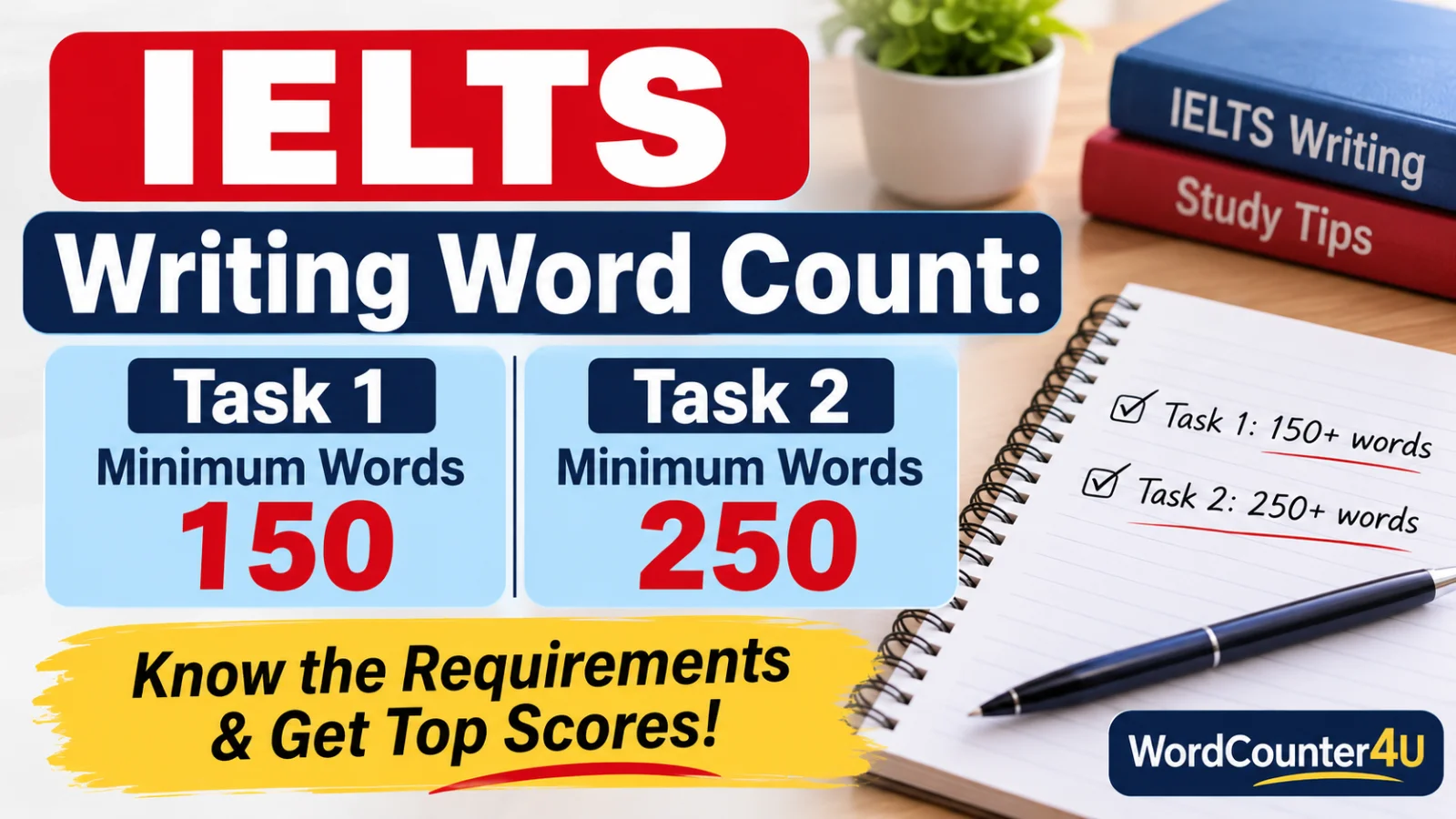
IELTS Writing Word Count: Task 1 and Task 2 Minimum Words
Learn the official IELTS Writing minimums (150 for Task 1, 250 for Task 2), penalties for under‑length, safe target word ranges, quick counting methods, and pacing tips.
On this page9 sections
You are practising IELTS Writing and the same worry keeps coming back: did I write enough? Maybe your Task 2 essay felt complete at 238 words. Maybe you wrote 340 and are wondering whether you wasted time. Maybe you handwrite and have no idea how to count under pressure.
This guide gives you the official minimums, explains what happens if you fall short, shows how many words to aim for, and gives you a quick way to count on paper and on a computer. It also covers the grey areas that cause real arguments in study groups, such as whether numbers, abbreviations and hyphenated words count.
IELTS Writing word count at a glance
The Writing test lasts 60 minutes and has two tasks. The British Council recommends spending about 20 minutes on Task 1 and about 40 minutes on Task 2. Here is how they compare:
| Task 1 | Task 2 | |
|---|---|---|
| Minimum words | 150 | 250 |
| Recommended time | About 20 minutes | About 40 minutes |
| Share of Writing score | One third | Two thirds |
| What you write | Academic: describe a chart, graph, table, process or map. General Training: a letter | An essay giving a position or discussing a question |
| Our practice target | 160 to 190 words | 270 to 290 words |
| Under the minimum | Penalised | Penalised |
| Over the minimum | No penalty, but it costs time | No penalty, but it costs time |
The minimums are the same for IELTS Academic and IELTS General Training. Only the content of Task 1 changes. Our practice targets are a suggestion, not an official figure, and we explain the reasoning below.
What happens if you write fewer than the minimum?
The British Council's test-format page says plainly that there is a penalty for under-length answers in both tasks. IELTS guidance describes the minimum as part of how Task Achievement (Task 1) and Task Response (Task 2) are assessed, which means a short answer is judged as not fully completing the task. In the sources we checked, the size of the penalty is not published, so any exact figure you see online is an estimate.
You will also find sites that say the penalty has been removed, or that being a few words under is fine. We would not rely on that. The official page states that the penalty exists, and the risk is not worth a handful of saved seconds.
There is a second, quieter problem. An answer that is well under the minimum rarely has room to develop its ideas. In Task 2, 200 words usually means a thin second body paragraph. In Task 1, 120 words usually means missing details or an overview. So even if you ignore the penalty, short answers tend to score lower for ordinary reasons.
Going over is different. IELTS says test takers are not penalised for writing more than the minimum in Task 1, but a longer Task 1 leaves less time for Task 2, which carries twice the weight. The same logic applies in reverse: a very long Task 2 usually means more mistakes and less time to check.
How many words should you actually aim for?
The minimum is a floor, not a target. If you aim for exactly 250 and your count is off by ten words, you are under. A small buffer solves this.
Many teachers suggest about 160 to 190 words for Task 1 and 270 to 290 words for Task 2. That range gives you a safe margin without eating into your time. It is practical advice rather than an IELTS rule, and it works because it leaves room for counting differences.
It also helps to think in paragraphs. Here is a planning budget that adds up to a safe length:
| Task | Section | About how many words |
|---|---|---|
| Task 2 | Introduction | 40 |
| Task 2 | Body paragraph 1 | 95 |
| Task 2 | Body paragraph 2 | 95 |
| Task 2 | Conclusion | 40 |
| Task 2 total | 270 | |
| Academic Task 1 | Introduction | 25 |
| Academic Task 1 | Overview | 40 |
| Academic Task 1 | Key details 1 | 50 |
| Academic Task 1 | Key details 2 | 50 |
| Task 1 total | 165 |
These are starting points. If you are in General Training Task 1, replace the sections with the three bullet points of the letter prompt and give each roughly equal space.
More is not better. A very long answer does not earn extra points and tends to drift off topic. For general guidance on essay lengths outside IELTS, see our word count guidelines.
How to count words quickly in the exam (paper vs computer)
On the computer-delivered test, you type your answer and see an on-screen word count, so you know when you have reached the minimum. You do not need a counting method, but practise anyway so you know what 270 words feels like.
On the paper-based test, you cannot count every word in the last minutes. Use the words-per-line method instead, and build the habit during practice so it takes seconds on test day:
- 1In practice, handwrite on lined paper and count the words in five full lines.
- 2Divide the total by five to get your average words per line.
- 3Note how many lines your finished answer covers.
- 4Multiply the two numbers for a quick estimate.
For example, if you average 11 words per line, 15 lines gives you about 165 words and 25 lines about 275. Your numbers will differ with your handwriting and the answer sheet, so calibrate yourself on paper that looks like the test.
Check your estimate against a real count after each practice answer. After a few attempts you will rarely need to count word by word.
Do numbers, abbreviations and hyphenated words count?
This is the most common argument in study groups, and the honest answer is that IELTS does not publish a detailed counting rulebook in the sources we found. Different tools count the same text differently, and so can different people.
To show how much it matters, we counted a deliberately number-heavy Task 1 style passage (231 characters) in four ways:
| Counting method | Words counted |
|---|---|
| Split on spaces only | 37 |
| Keep hyphenated words, decimals, dashes and slashes joined | 38 |
| Count letters-words and numbers as separate tokens | 44 |
| Split at every hyphen, dash and slash | 45 |
The passage is packed with compounds such as coal-fired and two-thirds, ranges such as 2010 to 2015 written with a dash, decimals and percentages, so the spread is exaggerated. A real answer will usually differ by far fewer words. But the lesson holds, especially in Task 1, where numbers are everywhere.
A safe habit: when you are close to the minimum, count the way that gives the lowest number. Treat a hyphenated word as one word, and do not count the dash in a number range as a separate word. If you pass the minimum that way, you are safe however it is counted. Then add a 10 to 15 word buffer on top.
How fast do you need to write? A quick pace check
A useful way to plan is to work out the words per minute you need. Divide the words by the minutes you spend writing, not planning:
| Task | Target words | Writing time | Pace needed |
|---|---|---|---|
| Task 1 | 170 | About 14 minutes | About 12 words per minute |
| Task 2 | 270 | About 30 minutes | About 9 words per minute |
| Task 2 | 290 | About 30 minutes | About 10 words per minute |
A suggested time split is below. It is our recommendation, built on the official 20 and 40 minute guidance:
| Task | Planning | Writing | Checking |
|---|---|---|---|
| Task 1 (20 minutes) | 2 to 3 minutes | 14 to 15 minutes | 2 to 3 minutes |
| Task 2 (40 minutes) | About 5 minutes | About 30 minutes | About 5 minutes |
These paces are slow for most keyboard users, so on the computer-delivered test the real constraint is planning and ideas, not typing speed. If you want to see where you stand, try our Typing Test and compare with our typing speed benchmarks. If you handwrite, time yourself, because handwriting is usually the slower route.
Practise with the Essay Word Counter
A short routine turns this from guessing into a habit:
- 1Set a timer for 20 minutes (Task 1) or 40 minutes (Task 2) and write a full answer.
- 2Type or paste it into the Essay Word Counter and note the count.
- 3Compare it with your target: 160 to 190 for Task 1, 270 to 290 for Task 2.
- 4Paste each paragraph into the Word Count Per Paragraph tool to see whether your introduction or one body paragraph is too long.
- 5If you handwrote it, count the lines and compare your estimate with the real number.
- 6Repeat with a new question. Over a few sessions your internal sense of length becomes reliable.
For a second opinion on any count, use the Word Counter. Our tools run in your browser, so your practice essays stay on your device.
Common mistakes
- Stopping at exactly 150 or 250. A small counting error then puts you under. Aim above.
- Padding with memorised phrases. Examiners read for ideas and language, and filler does not help your score.
- Writing 220 words in Task 1. A long Task 1 steals time from Task 2, which is worth twice as much.
- Skipping the overview in Academic Task 1. The overview is part of the task, so your word budget should include it.
- Counting every word in the last minutes. Use the words-per-line method on paper, and let the on-screen counter work for you on a computer.
Pre-exam checklist
- You know the minimums: 150 for Task 1 and 250 for Task 2.
- Your practice targets are 160 to 190 and 270 to 290 words.
- You know your words per line (paper) or you have practised with the live counter (computer).
- You have practised the 20 and 40 minute time split.
- You count conservatively near the minimum and keep a 10 to 15 word buffer.
- You have checked the latest format and rules on the official IELTS and British Council pages.
Was this guide useful?
Your vote is anonymous and helps us decide what to write next.
Written by
Muhammad Usman
CEO & Co-Founder · 5+ Years in Graphic Design | 3+ Years in Content Creation | Script Writing | Video Editing | Motion Graphics & Animation
I’m Muhammad Usman, CEO and Co-Founder of wordcounter4u.com. I have over five years of professional experience in graphic design and more than three years of experience in digital content creation. My professional background includes graphic design, content creation, script writing, video editing, motion graphics, animation, and digital media. I focus on creating practical digital experiences that combine clear communication, useful content, and thoughtful design. At wordcounter4u.com, I oversee the platform’s vision, content direction, branding, and overall growth. My goal is to build simple, reliable, and useful online tools and resources that help writers, students, professionals, and content creators work more efficiently.
Frequently asked questions
What is the minimum word count for IELTS Writing Task 1 and Task 2?
Task 1 needs at least 150 words and Task 2 at least 250 words. The minimums are the same for IELTS Academic and General Training.
Is there a penalty if I write fewer words?
Yes. The British Council's test-format page says there is a penalty for under-length answers in both tasks. The size of the penalty is not published, so do not write close to the minimum.
Is there a penalty for writing too many words?
No official penalty for going over, but a longer Task 1 leaves less time for Task 2, which is worth twice as much. A very long Task 2 also tends to contain more mistakes.
How many words should I aim for?
Many teachers suggest about 160 to 190 words for Task 1 and 270 to 290 for Task 2. This is advice, not an official rule, but it gives you a safe buffer.
Does the computer-delivered IELTS count my words?
Yes. The computer-delivered test shows an on-screen word count, so you can see when you have reached the minimum.
Do hyphenated words, numbers and abbreviations count as words?
IELTS does not publish a detailed rule in the sources we checked. Count conservatively when you are near the minimum, and keep a buffer of 10 to 15 words.
Which task should I spend more time on?
Task 2, which carries two thirds of your Writing score. Keep Task 1 near its target so you have the full recommended 40 minutes for Task 2.