What's a Good WPM? Typing Speed Benchmarks by Age, Job and Skill Level
Is 40 WPM good or slow? It depends on your age, your job, and how long you've been typing. Here are the real benchmarks, broken down by group — plus how the world record compares.
On this page10 sections
"Is 45 WPM good?" is a question that doesn't have one answer, because it depends entirely on who's asking and why. For someone typing a casual email, 45 WPM is comfortably above average. For someone applying to a transcription job with a stated 65 WPM minimum, the same number is a rejection. Typing speed benchmarks only mean something once you know which group you're actually being compared against — and, just as importantly, how the number was measured in the first place.
WPM, or words per minute, is the standard measurement for typing speed. It's calculated by taking the total number of characters typed, dividing by 5 (the standard length assumed for an average word, including spacing), and dividing again by the number of minutes the test ran. So a typist who enters 250 correct characters in one minute is credited with 50 WPM, regardless of how long or short the actual words in that passage happened to be. This standardization is what makes WPM scores comparable across different tests and typists, even though the underlying text is never identical word for word.
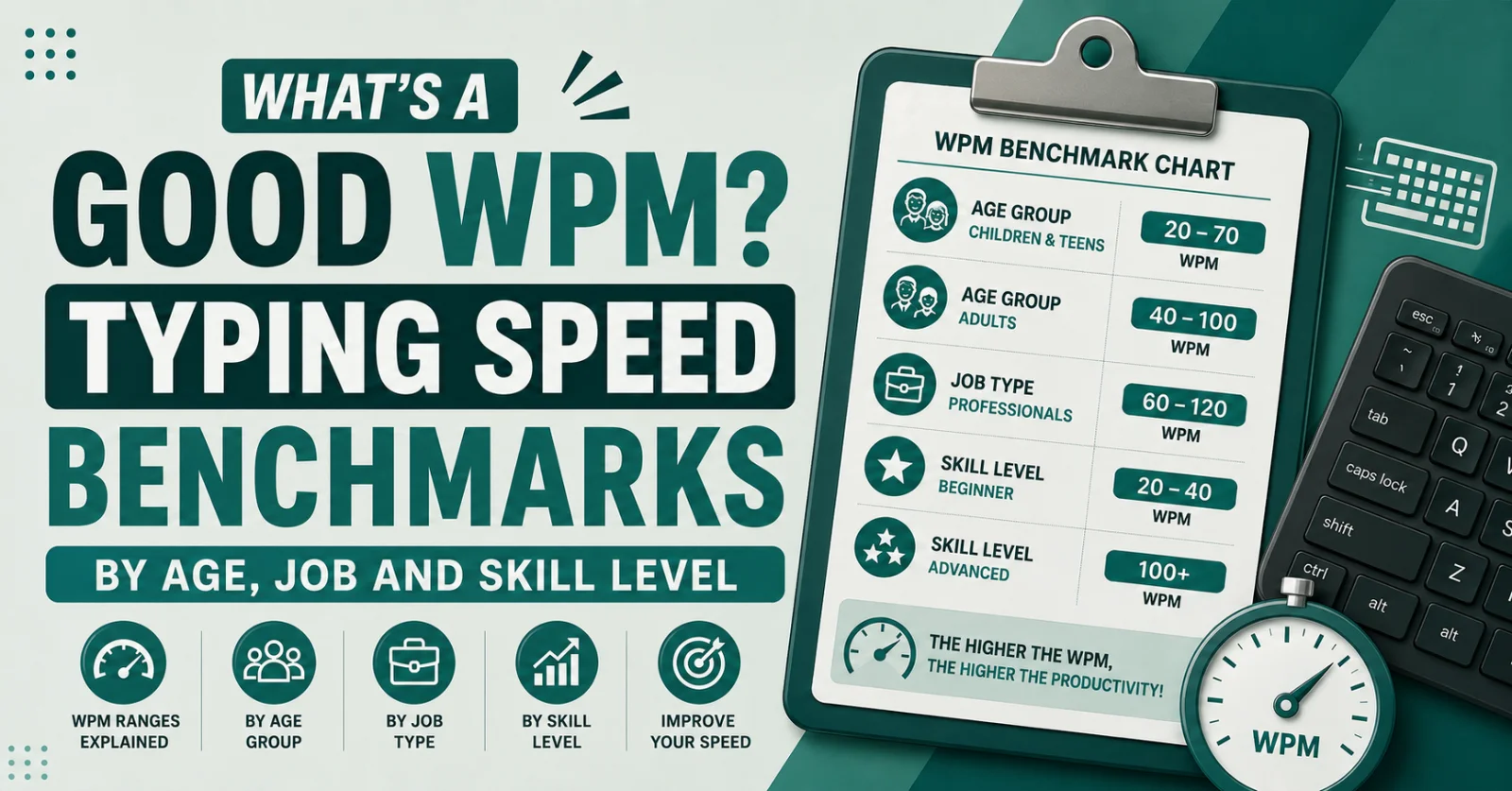
Average typing speed by age
Typing speed isn't a fixed trait — it's a learned motor skill that develops through repetition, similar to how handwriting speed develops through years of practice. This is why typing speed benchmarks by age show a fairly predictable curve: speed increases steadily through school and into early adulthood as keyboard exposure accumulates, plateaus through the peak working years, and gradually declines later in life as reaction time and fine motor control naturally slow.
| Age group | Average WPM | Notes |
|---|---|---|
| Children (8-10 years) | 15-25 WPM | Still developing basic finger placement and muscle memory |
| Pre-teens (11-13 years) | 20-30 WPM | Typing speed accelerates as school computer use increases |
| Teenagers (14-17 years) | 30-40 WPM | Often the first age group with regular daily typing (school, social use) |
| Young adults (18-25 years) | 40-45 WPM | Peak skill-acquisition years; heavy daily device use |
| Adults (26-45 years) | 40-50 WPM | Speed plateaus; professional typing habits solidify |
| Middle-aged adults (46-60 years) | 35-45 WPM | Generally still strong, with wide individual variation based on typing habits |
| Older adults (60+ years) | 25-35 WPM | Some natural decline in reaction time, though heavy daily typists often stay well above this range |
These ranges describe averages, not ceilings — plenty of teenagers who game or code regularly type well above 60 WPM, and plenty of adults in typing-heavy careers stay comfortably above 70-80 WPM well into later life. Age explains the general trend, not any individual's actual ceiling.
Average typing speed by job and skill level
Where age explains a general baseline, occupation is often the more practically useful benchmark, since it tells you what speed is actually expected of you rather than what's typical across the general population.
Casual/general use (40 WPM and up) covers most everyday computer use — email, messaging, basic office work. At this level, typing speed rarely becomes a bottleneck on its own, since most tasks are limited more by thinking time than typing time.
Standard office and administrative roles (50-60 WPM) typically expect typing speed that keeps pace with dictated thought — fast enough that typing doesn't visibly slow down meeting notes, correspondence, or documentation.
Customer support and live chat roles (55-70 WPM) often have typing speed baked directly into performance expectations, since response time is a measured metric and slow typing directly limits how many conversations an agent can handle at once.
Data entry roles (60-80 WPM, often with a numeric-pad speed requirement too) frequently list a specific WPM minimum in the job posting itself, since the entire role is built around typing volume and accuracy under time pressure.
Transcription and captioning roles (70-90+ WPM) tend to have the highest bar of any typing-focused profession, since transcriptionists are typing continuously against real-time or near-real-time audio, with accuracy requirements that leave very little room for correction time.
Professional programmers, interestingly, often type at more moderate speeds (40-60 WPM) despite spending huge amounts of time at a keyboard, since coding involves far more thinking, reading, and reviewing than continuous typing — raw WPM matters less here than in transcription-style roles, and a lot of "typing" time in code is actually navigation, indentation, and rereading rather than continuous forward text entry.
Stenotype operators — court reporters and live captioners using chorded stenography machines — are a category apart entirely. Because a stenotype machine allows multiple keys to be pressed simultaneously to represent whole syllables or phrases, trained stenographers can produce output equivalent to 200-300+ words per minute, far beyond what's achievable on a standard keyboard. This isn't a "typing speed" in the conventional sense — it's a fundamentally different input method — so stenotype WPM and standard keyboard WPM aren't directly comparable benchmarks.
| Role/context | Typical expected WPM | Why |
|---|---|---|
| Casual/everyday use | 40+ WPM | Typing rarely becomes the bottleneck at this level |
| Standard office/admin work | 50-60 WPM | Needs to keep pace with dictated thought and documentation |
| Customer support / live chat | 55-70 WPM | Response time is often a directly measured metric |
| Data entry | 60-80 WPM | Role is built around typing volume and accuracy |
| Transcription / captioning | 70-90+ WPM | Continuous typing against real-time audio, minimal room for correction |
| Software development | 40-60 WPM | Time split between typing, reading, and thinking |
| Stenotype (court reporting) | 200-300+ WPM equivalent | Chorded input, not comparable to standard keyboard typing |
| Competitive/hobbyist typists | 100+ WPM | Speed itself is the goal, achieved through dedicated practice |
If you're job hunting and see a posted minimum WPM requirement, it's worth taking it at face value rather than assuming it's a soft target — many employers, especially in data entry and transcription, use it as an actual screening cutoff before a candidate is even considered for other qualifications.
Quick lookup: is your WPM good?
Since a lot of people search for a very specific number rather than a general range, here's a quick-reference table for common WPM scores and roughly where they fall for a general adult typist:
| Your WPM | General rating |
|---|---|
| Under 20 WPM | Beginner — typical for someone still learning finger placement |
| 20-30 WPM | Below average — functional, but noticeably slower than typical daily use |
| 30-40 WPM | Approaching average — common for casual, infrequent typists |
| 40-50 WPM | Average — comfortably covers most everyday and light office tasks |
| 50-65 WPM | Above average — solid for most professional office roles |
| 65-80 WPM | Strong — meets or exceeds most data entry and live chat role requirements |
| 80-100 WPM | Very fast — well above typical job requirements, competitive-hobbyist range |
| 100+ WPM | Elite — top 5-10% of typists; approaching serious competitive territory |
A few specific numbers worth calling out directly, since they come up often: 40 WPM sits right around the general adult average, so it's a solid, unremarkable typing speed rather than either impressive or concerning. 30 WPM is below the typical adult average but still entirely usable for casual tasks — it would, however, fall short of most professional role minimums. 60 WPM comfortably clears the bar for the large majority of office and administrative jobs. 20-25 WPM is on the slower end for an adult but is a completely normal, expected range for a child or early learner still building the underlying motor skill.
How test duration changes your number
One detail that trips up a lot of people comparing scores across different tools: WPM results are not automatically comparable if the tests ran for different lengths of time. A 1-minute typing test tends to produce a slightly higher number than a 5-minute test taken by the same person, simply because a short burst is easier to sustain at peak effort than a longer, more demanding stretch that requires consistent focus and hand endurance throughout.
This is part of why serious typing benchmarks — including the Guinness World Record category — draw a real distinction between peak burst speed over a very short passage and sustained speed maintained over a longer duration. If you're comparing your own result against a published "good WPM" benchmark, it's worth checking whether that benchmark was based on a 1-minute test, a 5-minute test, or something else, since a 55 WPM result on a 5-minute test generally reflects a stronger underlying skill than the same number on a 1-minute test.
Typing speed vs. reading speed — two different measurements
A related but separate concept that often gets mixed into typing speed searches is reading words per minute, which measures how quickly someone reads and comprehends text rather than how quickly they produce it by typing. Average adult silent reading speed is typically cited in the 200-300 WPM range — a completely different scale from typing WPM, and not a number that should be compared directly against your typing score. The two skills use different cognitive and motor systems entirely: reading speed is limited by comprehension and eye movement, while typing speed is limited by motor coordination and keyboard familiarity. If you came across "250 WPM" in the context of reading benchmarks, that figure belongs to a different conversation than typing benchmarks, even though the unit ("words per minute") looks identical on the page.
World record typing speed, for context
It's worth knowing where the absolute ceiling sits, if only to put ordinary "good WPM" benchmarks in perspective. The Guinness World Record for typing speed is held by Barbara Blackburn, who was recorded reaching 212 words per minute using a Dvorak keyboard layout, with a sustained speed of around 150 WPM maintained over 50 minutes. That gap — between a genuinely excellent everyday typist at 80-100 WPM and a world-record-level 150+ WPM sustained — reflects years of deliberate, specialized practice rather than a small skill difference, which is a useful reminder that hitting 60-80 WPM is already a strong, professionally competitive result for the vast majority of jobs and everyday needs.
Why accuracy matters as much as raw speed
A fast typist with a high error rate often isn't actually faster in practice than a moderately-paced, accurate one — because every correction costs far more time than the keystroke that caused it. Backspacing, re-reading, and re-typing a mistyped word can easily cost 3-5 times the time it took to type it correctly the first time.
This is why most , including well-designed ones, report both WPM and an accuracy percentage rather than speed alone — and why a "good" typing speed benchmark should really be read together with accuracy, not as a standalone number. A typist who reaches 55 WPM at 98% accuracy is, in practical output terms, faster than one who reaches 65 WPM at 88% accuracy, once the time spent correcting mistakes is factored in.
Is typing speed trainable?
Yes, more than most people assume. Because typing speed is a motor skill built on repetition and muscle memory rather than an innate trait, most adults can meaningfully improve their WPM through short, focused practice — often gaining 10-15 WPM within a few weeks of consistent practice, especially if they're moving from an inefficient typing style (hunt-and-peck, looking at the keyboard) toward proper touch typing technique.
The most effective practice tends to be short and frequent rather than long and occasional — 10-15 minutes of focused practice most days outperforms an occasional hour-long session, since the skill is built through repetition, not endurance. Practicing specific weak points (a particular row of keys, certain letter combinations that consistently trip you up) tends to produce faster gains than repeatedly typing generic passages at a comfortable speed, since improvement comes from targeting the actual bottleneck rather than reinforcing what's already fluent.
Checking your actual typing speed
Because most people significantly over- or under-estimate their own typing speed based on how fast typing feels rather than how fast it actually is, the only reliable way to know your real WPM is to take an actual timed test rather than guessing. A typing speed test measures your words per minute and accuracy over a standardized passage, giving you a real number to compare against the benchmarks above — rather than relying on a subjective sense of "I type pretty fast."
Testing periodically (rather than once) is also useful if you're actively trying to improve, since it lets you track real progress over weeks rather than guessing whether practice is actually working. Testing at the same duration each time (always 1-minute, or always 5-minute) also keeps your own results comparable to each other, for the same reason different test lengths aren't directly comparable to each other's published benchmarks.
Conclusion
There's no single number that makes someone a "good" typist — the right benchmark depends on your age group, what your job actually requires, how long the test ran, and whether raw speed or accuracy matters more for the work you're doing. As a general anchor: 40 WPM is a reasonable baseline for everyday typing, 60 WPM comfortably covers most professional roles, and 80+ WPM is where specialized, typing-heavy jobs like transcription and data entry tend to set their bar — all of which sits well below the 150-212 WPM territory of world-record-level typists. Wherever you land, typing speed is one of the more trainable skills people assume is fixed — a real, measured baseline followed by short, consistent practice is enough to move the number meaningfully over time.
Was this guide useful?
Your vote is anonymous and helps us decide what to write next.
Frequently asked questions
What is considered a good typing speed?
For everyday use, 40+ WPM is generally considered good. For most professional office roles, 50-60 WPM is a reasonable expectation, while typing-intensive jobs like transcription or data entry often expect 70-90+ WPM.
Is 40 WPM good typing speed?
Yes — 40 WPM sits right around the general adult average, making it a solid, unremarkable everyday typing speed. It comfortably covers casual use, though some professional roles may expect somewhat higher.
Is 30 WPM good?
30 WPM is below the typical adult average of around 40 WPM, but it's still functional for casual, everyday typing. Most professional office roles expect somewhat higher, typically 50 WPM or above.
Is typing 20 WPM good?
20 WPM is on the slower end for an adult and would likely fall short of most professional typing requirements, but it's a completely normal range for a child or someone early in learning to type.
What's the average WPM for adults?
Most adults type between 40-50 WPM on average, though this varies significantly based on how much typing someone does regularly and whether they use proper touch-typing technique.
What is the world's fastest typing speed?
The Guinness World Record belongs to Barbara Blackburn, who reached 212 WPM using a Dvorak keyboard, with a sustained speed of roughly 150 WPM maintained over 50 minutes.
What's the minimum WPM required for most jobs?
It varies by role. General office jobs often expect 50-60 WPM, data entry roles commonly require 60-80 WPM, and transcription or captioning roles often set a minimum around 70-90 WPM.
Does a 1-minute typing test give a different result than a 5-minute test?
Yes. Short bursts, like a 1-minute test, are generally easier to sustain at peak speed than a longer 5-minute test, so results from tests of different lengths aren't directly comparable to each other.
Is typing speed the same as reading speed?
No. Typing WPM measures how fast you can produce text on a keyboard, while reading WPM measures how fast you read and comprehend text — typically 200-300 WPM for adults. They're unrelated skills measured on the same unit.
Can adults improve their typing speed?
Yes. Typing speed is a trainable motor skill, and most adults can gain 10-15 WPM within a few weeks through short, consistent practice, especially when moving from an inefficient typing style to proper touch typing.