How Is Your English Speaking Practice Score Calculated?
Learn how English speaking practice scores are calculated, including WPM, accuracy, completion, word-level feedback, and how to use your results effectively.
On this page14 sections
An English speaking practice score is only useful when you understand what the numbers measure. This guide explains WPM, accuracy, completion, word-level results, what can affect a score, and how to use your results to make the next practice session more useful.
How Is an English Speaking Practice Score Calculated?
There is no single formula used by every speaking practice tool. Different tools can measure different things, depending on whether the activity is a read-aloud exercise, a free-response task, a speaking test, or another type of practice.
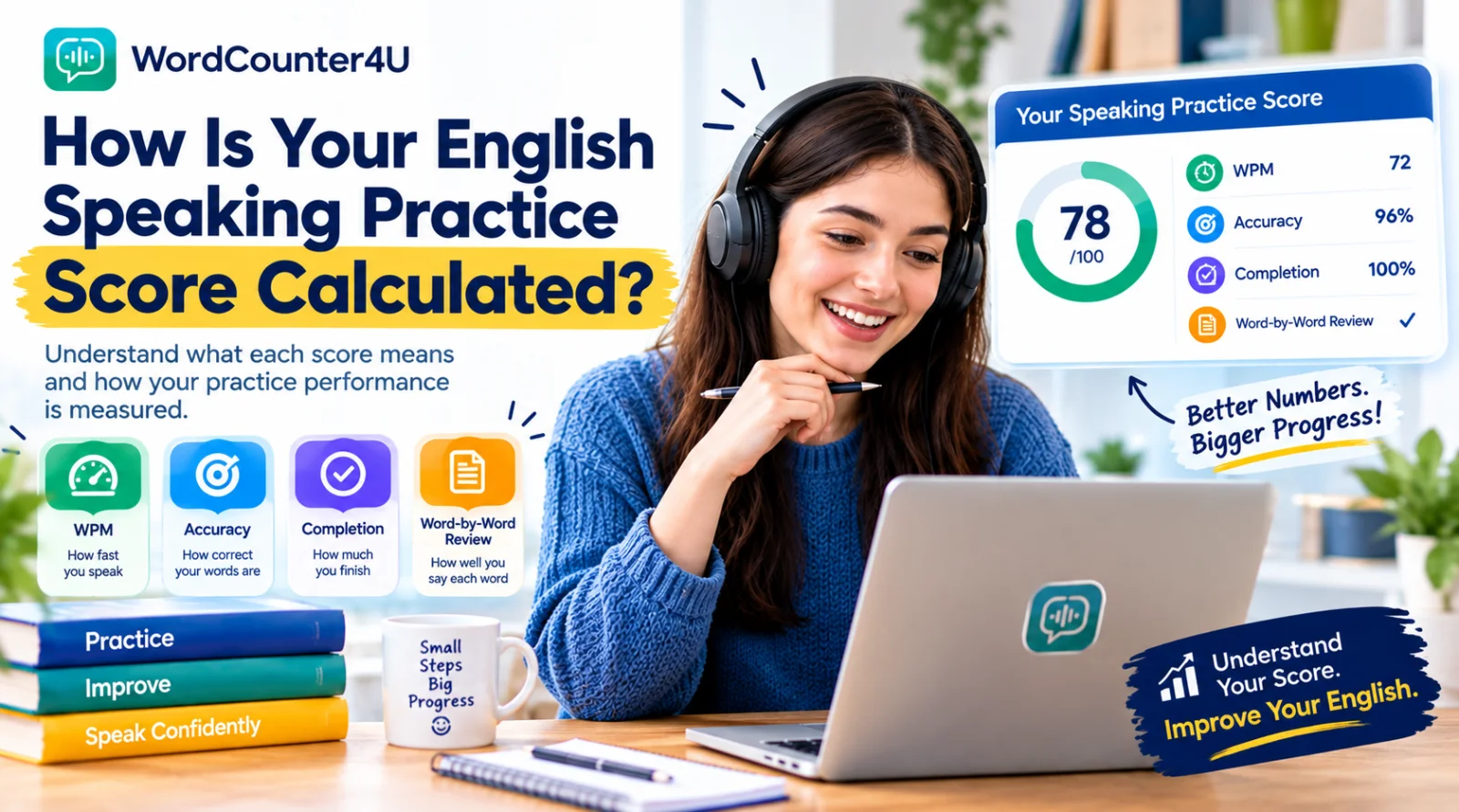
For a read-aloud tool such as WordCounter4U's Speaking Challenge, the score is based on what the browser recognises while you speak against the script. The current tool reports words per minute (WPM), accuracy, completion, and a word-by-word review. Recognition happens in the browser, and the product states that your voice is not recorded or uploaded to WordCounter4U.
The important point is that these measurements describe a particular practice session. They are not a complete measurement of your overall English ability.
What Does an English Speaking Practice Score Measure?
A useful speaking-practice result separates several aspects of performance instead of reducing everything to one number. In the Speaking Challenge, the main measures are WPM, accuracy, completion, and the word-by-word result. citeturn0search0
1. Words Per Minute (WPM)
WPM tells you how many words you produced per minute during the measured part of the session. In WordCounter4U's Speaking Challenge, WPM is based on correct matched words rather than simply counting everything that appeared in the script. citeturn0search0
WPM is useful for observing pace. For example, if you repeatedly complete similar scripts and your WPM gradually changes while accuracy remains stable, that gives you a practical indication of how your delivery pace is changing.
However, faster is not automatically better. A learner who rushes through a passage may increase pace while losing clarity, accuracy, or comfortable delivery. Use WPM as a measurement, not as the only target.
2. Speaking Accuracy
Accuracy looks at how much of the judged speech matched the expected words. The current Speaking Challenge describes accuracy as correctly matched words compared with the words that were judged, including matched, misread, and skipped words. Words that were never reached because the timer ended are handled through completion rather than being treated as accuracy mistakes. citeturn0search0
This distinction matters. Imagine a timed script where you read the first part accurately but the timer ends before you reach the final paragraph. Your completion can be lower because part of the script was not reached, while that unreached section does not automatically become a speaking error.
3. Completion
Completion tells you how much of the assigned script you actually reached during the session. It is especially useful in timed practice because running out of time is different from saying the wrong word.
For example, if you read 80% of a script before the timer ends, the result can show that incomplete coverage separately from the accuracy of the words that were actually judged. This gives you a clearer picture of what happened during the attempt. citeturn0search0
4. Word-by-Word Review
A percentage alone does not tell you which part of a script caused difficulty. The Speaking Challenge therefore returns the script with words marked as correct, misread, or skipped. citeturn0search0
This is often the most actionable part of the result. Instead of simply thinking, 'My score was low,' you can look for patterns: a particular phrase, unfamiliar vocabulary, a section that moved too quickly, or words that you repeatedly failed to match.
Why Can Two Speaking Practice Sessions Get Different Scores?
A score can change even when you feel that your English has not suddenly changed. The practice conditions also affect what the tool can measure.
· Script difficulty: Longer sentences, unfamiliar vocabulary, and more complex structures can require more attention.
· Speaking pace: If the teleprompter moves faster than you comfortably read, you may miss words.
· Recognition: Browser speech recognition does not recognise every utterance perfectly, so an automated result is not identical to a human assessment.
· Familiarity: A script you have already practised may feel easier because you know its wording.
· Completion: A timed run may end before you reach the full script, affecting completion separately from accuracy.
· Environment: Microphone position, background noise, browser behaviour, and the way you speak can affect recognition.
How Does WordCounter4U Calculate the Speaking Practice Result?
The current Speaking Challenge is a read-aloud practice tool. You choose a script, the text appears in a teleprompter, and the browser listens while you read. Recognised words are matched against the script and turn green during the session. When the run ends, the tool provides WPM, accuracy, completion, and a word-by-word review. citeturn0search0
The workflow is therefore not simply 'speak and receive one score.' It is a sequence of recognition and measurement steps that produces several pieces of feedback.
1. Choose a suitable challenge and level.
2. Set the teleprompter controls to a comfortable reading pace.
3. Allow microphone access when the browser requests it.
4. Read the script aloud while the browser processes recognised speech.
5. Review WPM, accuracy, completion, and the word-level result.
6. Use the result to decide what to practise next.
What Is the Difference Between WPM, Accuracy, and Completion?
| Measure | What it tells you | What it does not tell you |
|---|---|---|
| WPM | How quickly correct words were produced during the measured session. | Whether your speech was automatically judged perfect or whether you communicated naturally. |
| Accuracy | How much of the judged speech matched the expected words. | Your overall English ability or conversational skill. |
| Completion | How much of the assigned script you reached. | Whether the words you did read were pronounced perfectly in every respect. |
| Word-by-word review | Which words were matched, misread, or skipped. | A complete human evaluation of pronunciation, grammar, meaning, or interaction. |
Should You Try to Get the Highest Speaking Practice Score?
Not necessarily. A score is most useful when it helps you identify what to work on. Chasing a higher WPM number can be counterproductive if you start rushing or sacrificing accuracy.
A better review question is: 'What does this result tell me about my next practice session?' If accuracy is strong but you regularly fail to finish a timed script, you might adjust pace or choose a different duration. If completion is high but many words are misread, you may need to slow down and work on clearer delivery.
How Should Beginners Read Their Speaking Practice Results?
Beginners should not assume that one score defines their English level. Start by choosing material that is comfortable enough to read aloud without decoding every sentence.
· Look at whether you completed most of the selected material.
· Check the words marked misread or skipped.
· Notice whether the teleprompter pace felt manageable.
· Repeat a short difficult section instead of immediately moving to a harder script.
· Compare similar sessions over time rather than comparing unrelated scripts.
How Should Intermediate and Advanced Learners Use the Score?
More experienced learners can use the result to examine consistency and delivery under different conditions. Try different topics, longer scripts, professional material, or more demanding CEFR levels when the current material becomes comfortable.
WordCounter4U's Speaking Challenge currently provides scripts from A1 to C2 and durations from 30 seconds to 15 minutes, plus Practice Mode without a countdown. citeturn0search0
How Can You Improve a Speaking Practice Score?
Instead of repeating a challenge only to make the number larger, connect each practice attempt to one specific goal.
· For low completion: choose a more manageable duration or reduce the reading pace.
· For frequent skipped words: slow down and keep your attention on the moving text.
· For repeated misreads: review difficult vocabulary or sentences before repeating the passage.
· For inconsistent results: practise similar material regularly and compare sessions over time.
· For comfortable results: gradually increase difficulty, duration, or topic complexity.
A Simple 10-Minute Score Review Routine
7. Minutes 1–2: Choose a suitable script and check unfamiliar words.
8. Minutes 3–5: Complete the first read-aloud attempt at a comfortable pace.
9. Minutes 6–7: Review WPM, accuracy, completion, and the word-level result.
10. Minutes 8–9: Repeat the section that caused the clearest difficulty.
11. Minute 10: Write down one change for the next session.
Common Mistakes When Interpreting Speaking Scores
· Treating one score as your English level: A practice result describes one session under particular conditions.
· Chasing speed: Increasing WPM at the expense of accuracy can make the result less useful.
· Ignoring completion: A timed session that ends early tells a different story from a fully completed script.
· Ignoring word-level feedback: The detailed review can show exactly where the problem occurred.
· Comparing unrelated scripts: Difficulty, length, vocabulary, and topic can change the practice experience.
· Assuming automated recognition equals human assessment: Speech recognition provides useful automated feedback, but it does not assess every aspect of real communication.
Can a Speaking Practice Score Measure Your Overall English Ability?
No single automated practice score can represent every part of English speaking. Real communication also involves listening, turn-taking, spontaneous responses, vocabulary choice, grammar, pronunciation, meaning, and adapting to another person.
A speaking-practice score is better understood as a measurement of the activity it was designed to measure. Use it alongside other forms of practice, including listening and real conversation when those skills are part of your goal.
When Is a Speaking Practice Tool Useful?
A structured tool can be useful when you want repeatable practice and feedback without having to organise a conversation partner. It can give you a defined script, a practice duration, and measurable results.
If you are new to this type of practice, start with What Is an Online English Speaking Practice Tool? to understand the basic concept and how a speaking tool fits into a wider learning routine.
For practical solo methods, see How to Practice English Speaking Online Without a Partner for exercises, prompts, role-plays, and a short routine.
For a detailed explanation of the workflow, read How Does an English Speaking Practice Tool Work?. If Article #3 is not yet published, add this link in the CMS after its final live URL is confirmed.
Conclusion
An English speaking practice score is most useful when you understand what each measurement represents. WPM gives you information about pace, accuracy shows how much of the judged speech matched the expected words, completion shows how much of the assigned material you reached, and word-level review helps identify specific difficulties.
Use these measurements as feedback rather than as a complete definition of your English ability. Choose suitable material, practise consistently, review the result, and make one practical adjustment for the next session.
Was this guide useful?
Your vote is anonymous and helps us decide what to write next.
Frequently asked questions
How is an English speaking practice score calculated?
It depends on the tool. WordCounter4U's Speaking Challenge reports WPM, accuracy, completion, and a word-by-word review based on recognised speech matched against the selected script.
What does WPM mean in speaking practice?
WPM means words per minute. It gives you a reference for speaking pace during the measured practice session.
Does a higher WPM mean better English speaking?
Not by itself. A higher pace is only useful if you can maintain clear and accurate delivery.
What is speaking accuracy?
In the Speaking Challenge, accuracy reflects correctly matched words among the words judged during the run. Completion is tracked separately.
What is completion in a speaking practice tool?
Completion indicates how much of the assigned script you reached during the session. It helps distinguish an unfinished timed run from words that were actually misread.
Why did some words not turn green?
The current Speaking Challenge notes that reading too quickly is a common reason. Lowering the teleprompter scroll speed can help, while browser speech recognition can also occasionally miss or misrecognise short words.
Can I improve my speaking score by practising regularly?
Regular practice can give you more opportunities to work on the specific behaviours measured by the tool. Compare similar sessions over time and use the detailed result to choose what to practise next.
Does WordCounter4U record my voice?
The current Speaking Challenge states that no recording is made and audio is not uploaded to WordCounter4U; speech recognition is handled by the browser's own service.