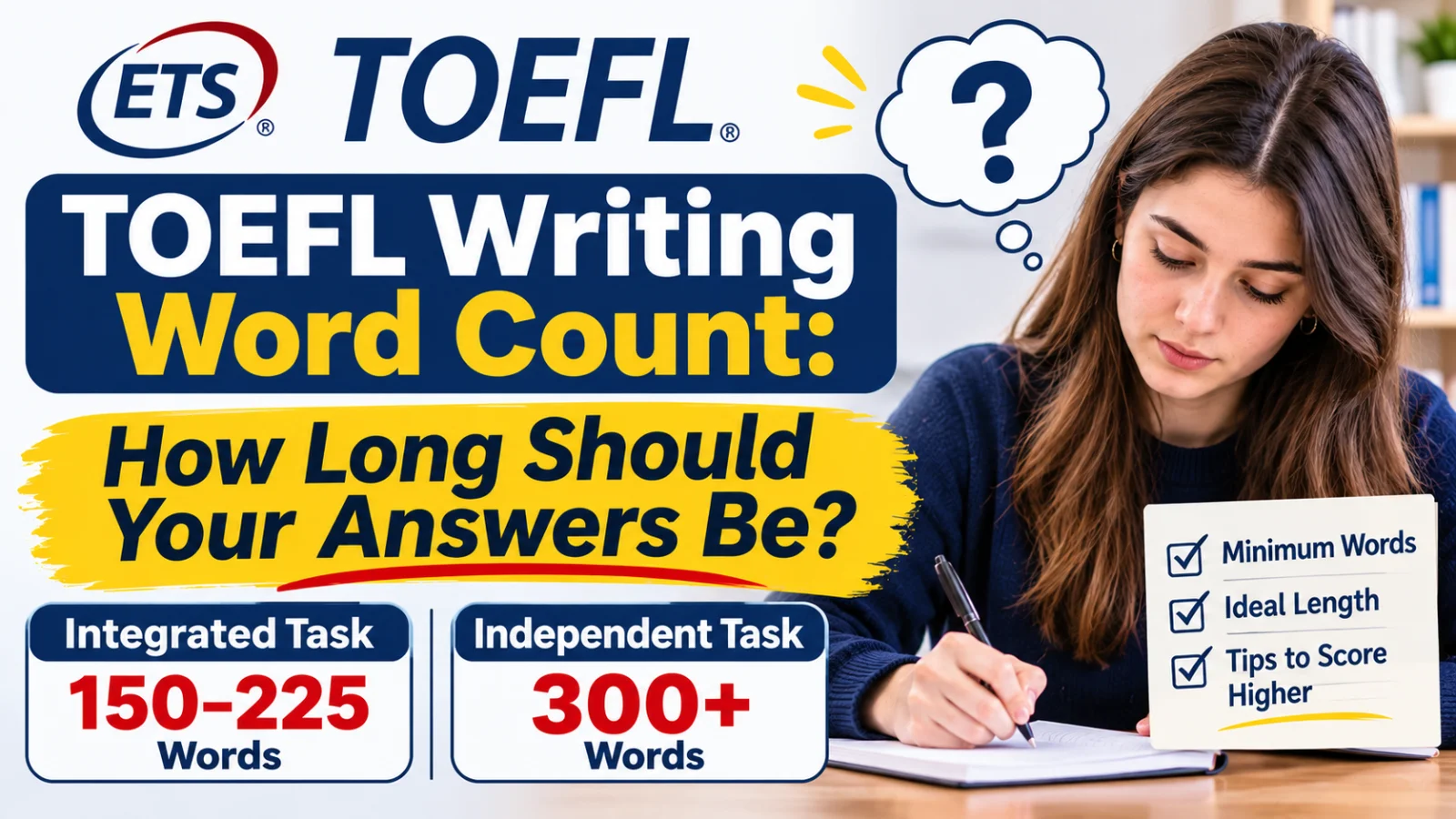
TOEFL Writing Word Count: How Long Should Your Answers Be?
Learn the new TOEFL iBT Writing format (post‑Jan 2026), word‑count targets for Email (≈100‑130 words) and Academic Discussion (≈120‑150 words), timing tips, typing‑speed advice, and common pitfalls.
On this page9 sections
You are preparing for TOEFL Writing and you keep finding conflicting advice. One site says 300 words, another says 100, and a third says there is no limit at all. They are not all wrong. They are describing different versions of the test.
The TOEFL iBT changed on 21 January 2026, and the old long essays are gone. This guide explains the format you will actually sit, what ETS says about length for each task, how many words to aim for, how long it takes to type that many words, and how to practise at the right length without padding.
TOEFL Writing tasks and recommended lengths
According to ETS, the Writing section now has 12 items across three task types and takes about 23 minutes of base time. The test is adaptive, so timing and item counts can vary. Here is how the three tasks compare on length:
| Task | Time | What ETS says about length | Our practice target |
|---|---|---|---|
| Build a Sentence | Part of the 23 minutes (10 items) | Not applicable. You arrange words and phrases into a correct sentence | No word count |
| Write an Email | 7 minutes in total to read and respond | No word count is published. The sample prompt says to write as much as you can, in complete sentences | About 100 to 130 words |
| Write for an Academic Discussion | 10 minutes in total to read and respond | A recommended minimum of 100 words, and an effective response contains at least 100 | About 120 to 150 words |
The targets in the last column are our suggestion, built from the ETS guidance and sample responses. They are not official numbers, which is why we explain the reasoning below. Before the January 2026 change, Writing had a 20-minute integrated task plus the Academic Discussion task. The email task and Build a Sentence are the new parts.
For the current structure, check the ETS Test Content and Structure page, which lets you switch between the format before and after 21 January 2026.
Is there a minimum or maximum word count?
Write for an Academic Discussion. ETS's teaching materials state that you should write a minimum of 100 words, and the sample tasks repeat that an effective response contains at least 100 words. No maximum is published in the sources we checked.
Write an Email. We did not find an official word count. The ETS sample task tells you to write as much as you can and in complete sentences. You will see ranges like 80 to 120 words on prep sites, but those are practice targets from teachers, not ETS rules.
Two official details matter for how you practise:
- ETS says the Email and Academic Discussion tasks include a word count function, so you can see your length while you type.
- No Writing task includes a spell-check function, so a typo stays a typo.
One more thing worth knowing: ETS's own sample Academic Discussion response in its lesson plan is only about 80 words by our count, even though the task asks for at least 100. That sample is a classroom reading exercise, not a guaranteed top-scoring answer. We would treat 100 words as a real target and not count on being forgiven for falling short.
Why older word count advice no longer works
A lot of articles still describe an Integrated essay of a few hundred words and a longer Independent essay. Those tasks are no longer part of the test. Here is how to spot outdated advice quickly:
- It mentions an Integrated or Independent Writing task.
- It describes a Writing section of around 50 minutes.
- It talks about a Writing score out of 30.
- It was published before 2026 and has not been updated.
The current test reports scores on a 1 to 6 scale, with a comparable 0 to 120 score also given during a transition period. If a guide does not mention Build a Sentence and Write an Email, it is almost certainly describing the old format.
Quality vs length: what scorers actually reward
Length alone does not earn points. The ETS materials describe what a strong response does:
- Academic Discussion: it states and supports an opinion, contributes something to the discussion, and uses the professor's question and classmates' posts. The writing should be clear, cohesive and accurate, with a range of grammar and vocabulary.
- Write an Email: it addresses the scenario and every point in the prompt, elaborates enough to be useful, is clear, and uses a range of structures and vocabulary accurately.
The ETS sample email prompt lists three things to do: say what you like, describe a problem, and ask a question. The sample response covers all three and runs about 118 words by our count. That tells you something practical: coverage drives length. If you answer every bullet with a sentence or two of detail, you will land in a sensible range without trying.
A simple word budget helps:
| Task | Part | About how many words |
|---|---|---|
| Greeting and opening line | 8 | |
| Point 1 | 30 | |
| Point 2 | 35 | |
| Point 3 | 25 | |
| Closing | 10 | |
| Email total | 108 | |
| Academic Discussion | State your opinion | 20 |
| Academic Discussion | Reason and example | 50 |
| Academic Discussion | Respond to a classmate | 35 |
| Academic Discussion | Closing thought | 15 |
| Academic Discussion total | 120 |
These are planning figures. Scale them up a little if you have time, and always cover every bullet in the prompt before adding extra detail.
How to practise at the right length under time pressure
The time limits are tight. Remember that the 7 and 10 minutes include reading the prompt, not just writing. Here is a suggested split, which is our recommendation:
| Task | Read | Plan | Write | Check |
|---|---|---|---|---|
| Email (7 minutes) | About 1 minute | About 1 minute | About 4.5 minutes | About 30 seconds |
| Academic Discussion (10 minutes) | About 1.5 minutes | About 1 minute | About 6.5 minutes | About 1 minute |
To build the habit:
- 1Practise each task on its own timer, not as one long block.
- 2Always read the whole prompt first. For Academic Discussion, read the professor and both classmates before you write.
- 3Plan one sentence per bullet or per part of your budget.
- 4Write in complete sentences and move on. You have no spell-check, so keep your language accurate and simple.
- 5Use your last minute to check that every bullet is covered.
Typing speed: how fast do you need to be?
This is the biggest change from the old essay-based test, and most older guides skip it. You type your answers, so the time you need depends on your typing speed. We calculated how long it takes to type the target lengths, without any thinking pauses:
| Words | At 20 WPM | At 30 WPM | At 40 WPM | At 50 WPM |
|---|---|---|---|---|
| 110 | 5.5 min | 3.7 min | 2.8 min | 2.2 min |
| 120 | 6.0 min | 4.0 min | 3.0 min | 2.4 min |
| 140 | 7.0 min | 4.7 min | 3.5 min | 2.8 min |
To write 120 words in the 4.5 minutes we suggest for the email, you need about 27 words per minute with no pauses. To write 140 words in 6.5 minutes for the discussion post, you need about 22. Real writing includes pauses to think, so a comfortable speed is well above those numbers. If you type below about 30 words per minute, you may find yourself running out of time before you run out of ideas.
Test your speed with our Typing Test, and compare your result with our typing speed benchmarks. Also practise on a plain keyboard setup similar to the test, with autocorrect off.
Count your practice answers with the Word Counter
A routine for each practice session:
- 1Set the timer for 7 minutes (Email) or 10 minutes (Academic Discussion), including reading time.
- 2Write in a plain-text editor with spell-check and autocorrect turned off, to match the test.
- 3Paste your answer into the Word Counter and compare it with your target.
- 4Check that every bullet in the prompt is answered. If your word count is low, the cause is usually a missing bullet, not missing filler.
- 5Re-type any answer you made typos in, and note your recurring mistakes.
- 6For a longer set of practice answers, the Essay Word Counter gives you the totals in one place.
Our tools run in your browser, so your practice answers stay on your device. If you are also preparing for IELTS, our guide to the IELTS Writing word count covers a very different system, with fixed minimums on longer essays.
Common mistakes
- Following old advice. Writing 300 words in a 7-minute email task is impossible and pointless.
- Missing one of the bullets. In the email task, skipping a required point costs more than being a few words short.
- Padding to reach a number. For Academic Discussion, repeating the same point in new words does not add value. Add a new reason or respond to a classmate instead.
- Ignoring the classmates' posts. The task asks you to contribute to the discussion, so reference at least one post.
- Relying on spell-check. None of the tasks has one, so practise without it.
- Typing too slowly. If you finish the thinking but not the typing, practise typing separately.
Pre-exam checklist
- You know the current format: Build a Sentence, Write an Email, Write for an Academic Discussion.
- Academic Discussion answers reach at least 100 words, ideally around 120 to 150.
- Email answers cover every bullet, in roughly 100 to 130 words.
- You have practised the 7 and 10 minute timers, including reading time.
- You have measured your typing speed and know your pace.
- You have practised without spell-check and autocorrect.
- You have checked the latest format and rules on the ETS website.
Was this guide useful?
Your vote is anonymous and helps us decide what to write next.
Written by
Muhammad Usman
CEO & Co-Founder · 5+ Years in Graphic Design | 3+ Years in Content Creation | Script Writing | Video Editing | Motion Graphics & Animation
I’m Muhammad Usman, CEO and Co-Founder of wordcounter4u.com. I have over five years of professional experience in graphic design and more than three years of experience in digital content creation. My professional background includes graphic design, content creation, script writing, video editing, motion graphics, animation, and digital media. I focus on creating practical digital experiences that combine clear communication, useful content, and thoughtful design. At wordcounter4u.com, I oversee the platform’s vision, content direction, branding, and overall growth. My goal is to build simple, reliable, and useful online tools and resources that help writers, students, professionals, and content creators work more efficiently.
Frequently asked questions
How many words should I write for TOEFL Writing?
For Write for an Academic Discussion, ETS recommends at least 100 words. For Write an Email, ETS publishes no word count, so aim to cover every point in the prompt, which usually takes about 100 to 130 words. Build a Sentence has no word count.
Is there a maximum word count?
No maximum is published in the ETS sources we checked. Going far beyond the target costs you time you need for checking.
Does the TOEFL still have 300-word essays?
No. The long Independent and Integrated essays were replaced in January 2026 by Build a Sentence, Write an Email and Write for an Academic Discussion.
Is there a word counter in the test?
Yes for the Email and Academic Discussion tasks. ETS says those tasks include a word count function.
Is there a spell-check?
No. ETS states that no Writing task includes spell-check, so practise without it.
How long do I have for each task?
Seven minutes for Write an Email and ten minutes for Write for an Academic Discussion, in both cases including the time to read the prompt.
How fast do I need to type?
To type about 120 words in around 4.5 minutes you need roughly 27 words per minute with no pauses, so a comfortable speed is higher. Test yourself and practise if you are below about 30.