How Do I Not Get Nervous During the SSC Typing Test?
Nerves during the SSC typing test usually come from one thing: not having practiced under real exam conditions. Here's how to fix that before test day.
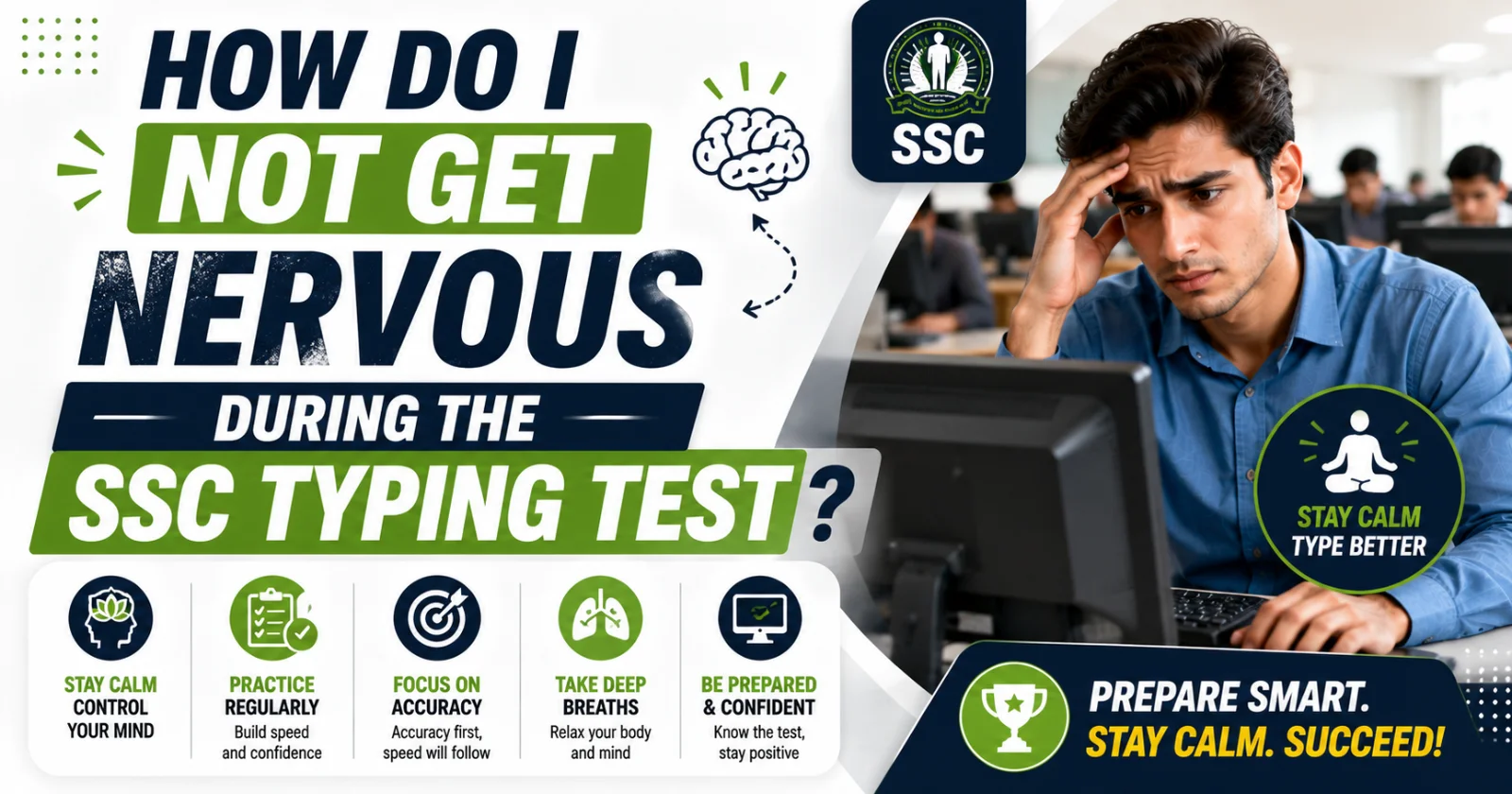
On this page7 sections
Let's name the actual problem first, because it's usually not what people think. Most candidates assume they're nervous because they're "not fast enough." In my experience talking through this with people, that's rarely the real issue — most candidates preparing seriously for the SSC typing test can already type at or above the required speed in practice. The nerves come from somewhere else: the exam room feels unfamiliar, the interface looks different from what you practiced on, and the silence and pressure of a real test change how your hands behave, even though your actual skill hasn't changed.
Once you understand that the nervousness is really about unfamiliarity, not ability, the fix becomes obvious: make the real exam feel as familiar as your regular practice sessions. That's what this whole article is built around.
Know exactly what you're walking into
A lot of anxiety comes from not knowing precisely what will happen once you sit down. So let's remove that uncertainty first.
For SSC CHSL, here's the shape of the test: you'll be given a passage to type within a fixed window, and your speed is measured as net WPM — meaning your raw typing speed minus a penalty for mistakes, not just how many words you managed to bang out. The passage appears on one part of the screen, and you type it into another part below. You choose English or Hindi typing at the application stage, not on test day, so that decision is already locked in well before you walk into the exam.
The specific speed requirement depends on the post you're applying for, and the exact rules (like whether backspace is enabled, and the precise error tolerance) can shift slightly between notification cycles — which is exactly why the single most important thing you can do is read your own notification PDF carefully rather than relying on what worked for someone else's exam cycle. Don't guess or go off what a friend told you from two years ago; the rules for your specific post and year are the only ones that matter.
Once you know the actual rules for your test — the duration, the required speed, the error tolerance, whether corrections are allowed — a huge amount of the "unknown" that fuels nervousness simply disappears.
The real fix: practice under exam conditions, not comfortable conditions
Here's something worth sitting with: if you only ever practice typing in relaxed, low-pressure conditions — no timer, no consequences, background music playing — then the real exam is going to feel like a completely different activity, because in a real sense, it is. Your brain has never rehearsed the actual conditions it's about to face.
So the fix is to deliberately practice under conditions that resemble the real test as closely as possible:
- Use the same duration every time. If your test window is 10 minutes, don't keep practicing in short 1-minute bursts and hoping it transfers. Run full 10-minute mock sessions regularly, since a typing test of 10 minutes tests something different than a typing speed test one minute long — sustained focus and hand endurance, not just a quick burst.
- Practice with the pressure of a countdown visible. A visible timer changes how your body responds, even if your typing skill is identical. Get used to seeing time tick down while you type.
- Practice in silence, sitting the way you'll sit in the exam hall. If you normally practice slouched on a bed with music on, and the real exam is a silent, formal computer lab, that mismatch alone can throw you off on test day.
- Simulate the error rules exactly. If corrections are limited or restricted in your specific exam format, disable or limit backspace during some of your practice sessions too, so the restriction itself isn't a surprise.
This is really the core idea behind reducing exam nerves for any timed skill test, not just typing: nervousness thrives on novelty, and repetition kills novelty. The twentieth time you sit through a full mock test under real conditions, your body simply doesn't react the same way it did the first time.
Build a speed buffer, not a bare minimum
If you're practicing to hit exactly 35 WPM and nothing more, you're setting yourself up for a stressful test day, because any dip in performance under pressure — and a small dip is completely normal — could put you below the cutoff. This is one of the most common, and most avoidable, sources of last-minute panic.
Instead, train to a comfortable buffer above the requirement. If English typing needs 35 WPM to qualify, aim for your regular practice sessions to land around 40-42 WPM with strong accuracy. That gap gives you room to lose a little speed to nerves on the actual day and still clear the requirement comfortably. Walking into the exam already knowing you have margin changes how the whole experience feels — you're not typing right at the edge of failing, you're typing well within a safety zone.
A short pre-test routine that actually helps in the moment
Beyond long-term preparation, there are a few things worth doing in the minutes right before you sit down that measurably reduce nervousness in the moment, not just in theory.
Slow, deliberate breathing for 60 seconds. This sounds almost too simple to matter, but slower breathing directly reduces the physical symptoms of nervousness — the racing heart, the shaky hands — which are exactly the things that hurt typing accuracy. You don't need anything elaborate: four seconds in, four seconds out, repeated for about a minute before your test starts.
Do a short hand warm-up, not a cold start. Typing your first sentence with completely cold, unwarmed hands often produces the very first mistakes of the test, which then compounds anxiety for the rest of it. A couple of minutes of relaxed typing beforehand — even just typing a few sentences on scratch paper mentally or on a demo screen if one's provided — helps your hands settle before it counts.
Read the passage's opening line calmly before you start typing, if you get a preview. Rushing into the very first word without a beat of composure is a common, avoidable mistake. A brief pause to read and settle costs you almost no time relative to the whole test, but it prevents a shaky, error-prone start.
Remind yourself of your buffer. If you know you've been consistently hitting 40+ WPM in practice against a 35 WPM requirement, actively remind yourself of that fact right before starting. This isn't just a feel-good affirmation — it's an accurate fact about your actual preparation, and treating it as evidence (not just encouragement) genuinely helps.
What to do if you make an early mistake during the test
One specific moment causes a disproportionate amount of panic: making a visible mistake in the first minute of the test. The instinct is to panic and rush to compensate, which almost always causes more errors, not fewer.
The better response, and one worth deliberately practicing during your mock sessions: notice the mistake, correct it if the format allows, and continue at your normal pace — don't speed up to "make up for it." A single early mistake, corrected calmly, has almost no real effect on your final net WPM. A panic spiral after that mistake absolutely does.
Track your real numbers so confidence is based on evidence, not hope
A lot of pre-test anxiety comes from genuine uncertainty about your own ability — not knowing, deep down, whether you can actually hit the number. The fix for that specific kind of nervousness isn't a mindset trick; it's data. Test yourself regularly and honestly using a real typing speed test that shows both your WPM and your accuracy, and keep a simple log across your practice weeks.
When you can look back at two or three weeks of consistent mock results sitting comfortably above your required speed, your confidence going into the real test is no longer a hope — it's a documented pattern. That distinction matters more than it sounds like it should, because genuine evidence-based confidence handles pressure far better than optimism alone.
If your baseline speed itself still needs work before you get to the buffer-building stage, our guide on typing training for beginners and reaching 50 WPM from 30 walks through a structured plan for building speed in the first place. And if you're not sure whether your current technique has a hidden ceiling that's making this harder than it needs to be, touch typing vs. hunt-and-peck is worth a look before test day, not after.
Putting it together
Here's the short version, in the order that actually matters:
- 1Read your specific SSC notification carefully so there's no uncertainty about the actual rules for your post
- 2Practice under real exam conditions — same duration, same silence, same pressure — not just comfortable, low-stakes sessions
- 3Train to a speed buffer well above the minimum requirement, not exactly at it
- 4Use a short breathing and hand warm-up routine right before the test starts
- 5Practice staying calm through an early mistake specifically, since panic after one small error causes more damage than the error itself
- 6Track your real practice numbers over several weeks so your confidence is based on evidence
Nervousness during a timed test like this is almost always a symptom of unfamiliarity, not a lack of skill. Every mock session you run under real conditions chips away at that unfamiliarity a little more, until test day starts to feel like just another practice run — because, by then, it genuinely is one.
Was this guide useful?
Your vote is anonymous and helps us decide what to write next.
Frequently asked questions
What typing speed do I need for the SSC CHSL typing test?
Candidates typically need 35 WPM for English typing or 30 WPM for Hindi typing, measured as net WPM within a fixed time window — always confirm the exact figure against your current notification, since requirements can vary by post.
Why do I get nervous during typing tests even though I can type fast enough in practice?
This usually happens because practice conditions differ from the real exam — unfamiliar interface, visible timer, silence, and pressure all change how your hands perform even when your underlying skill hasn't changed.
How can I practice under the same conditions as the real SSC typing test?
Run full-length mock tests matching your exact exam duration, practice in silence with a visible countdown timer, and replicate any error or correction rules from your specific notification rather than practicing under more relaxed conditions.
Should I aim for exactly the required WPM or higher?
Aim higher. Training to a speed buffer several words per minute above the minimum requirement gives you room to lose some speed to nerves on test day and still comfortably qualify.
What should I do if I make a mistake early in the typing test?
Correct it calmly if the format allows and continue at your normal pace. Rushing to compensate after an early mistake causes more errors than the original mistake itself.
How can I build genuine confidence before a typing test instead of just trying to stay positive?
Track your practice results honestly over several weeks using a real timed typing test. Seeing a consistent pattern of results above your required speed gives you evidence-based confidence, which holds up better under pressure than general optimism.