Word Count Benchmarks FAQ: How Long Should It Be?
How many words is a blog post, an essay, a 5-page paper, or a 5-minute speech? Quick answers to the most common word count and length questions.
On this page6 sections
"How many words should this be?" rarely has one universal answer, which is exactly why this page exists. Here you'll find quick, direct answers to specific length questions across blogging, academic writing, professional communication, social media, and everyday conversions like pages-to-words and speaking time — pulled from the most common real searches people run into.
If you need the fuller picture with reasoning and tables, our in-depth guide on Word Count Benchmarks by Content Type covers the same ground in more detail. This page is built for quick lookups.
A. Blog & Content Writing (20)
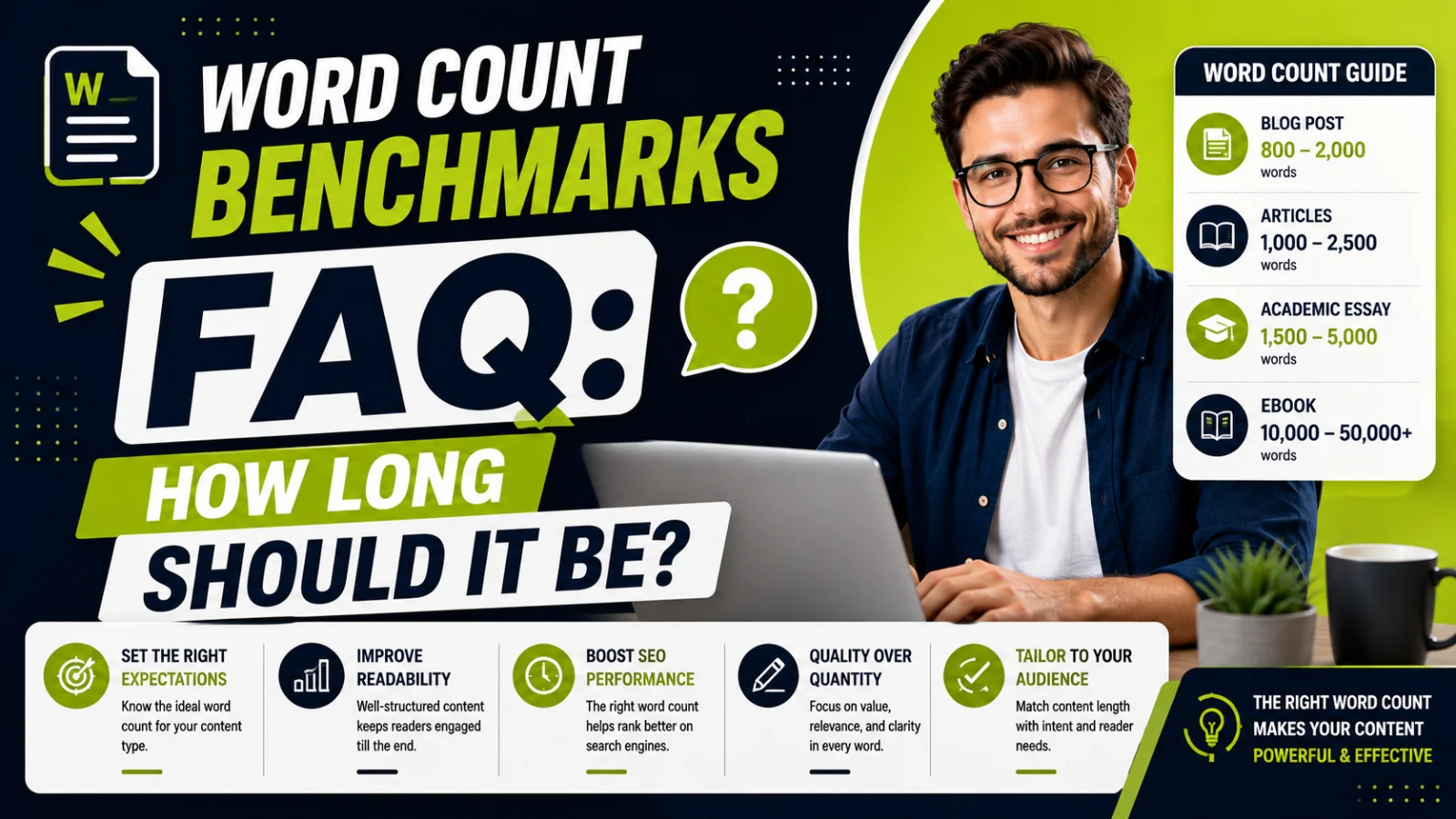
Q1: How many words should a blog post be? Most blog posts aimed at ranking in search perform best between 1,000-2,500 words, though the ideal length depends heavily on the topic's complexity and how much competing content already exists.
Q2: What's the ideal word count for a listicle? Listicles typically run 1,200-2,000 words, with length scaling based on how many items are included and how much useful detail each item needs.
Q3: How long should a "how-to" blog post be? A standard how-to or explainer post usually works well at 1,000-1,800 words, enough to cover the process fully along with context and common pitfalls.
Q4: How many words should a news article be? News or timely update posts are typically shorter, often 400-800 words, since speed and clarity matter more than exhaustive coverage for time-sensitive content.
Q5: What's a good word count for a comparison ("X vs Y") post? Comparison posts generally run 1,500-2,500 words, since they need to cover both sides fairly with enough supporting detail to actually help a reader decide.
Q6: How long should a pillar page or complete guide be? Pillar content is expected to be comprehensive, typically running 2,500-4,000+ words to thoroughly cover a broad topic.
Q7: Is a 500-word blog post too short? Not necessarily — for a direct, narrowly-scoped question, 500-900 words can fully answer the query. It becomes too short only if the topic genuinely requires more depth to be useful.
Q8: Does a longer blog post always rank better in Google? No. Longer content tends to perform well when the added length reflects real depth and covers more of a reader's questions — padding a post to hit a word count without adding value usually doesn't help rankings.
Q9: How many words should a product review be? Product reviews typically run 800-1,500 words, enough to cover features, pros and cons, and a genuine recommendation without becoming excessive.
Q10: What's the average word count of a top-ranking blog post? This varies significantly by niche and competitiveness, but well-ranking posts in competitive categories often run 1,500-2,500+ words.
Q11: How long should an "ultimate guide" article be? Given the comprehensive framing readers expect from that title format, these tend to run 2,500-5,000+ words.
Q12: How many words is a typical newsletter blog recap? A blog-style newsletter recap is often shorter than a standalone post, commonly 300-600 words, since it's meant to be skimmed quickly.
Q13: What word count is best for SEO in 2026? There's no fixed universal number — search engines reward thorough, well-organized coverage of a topic, which naturally varies by query, so matching content depth to search intent matters more than hitting a specific word count.
Q14: How long should a case study blog post be? Case studies typically run 1,200-2,000 words, enough to establish context, present results, and explain the approach in enough detail to be credible.
Q15: Should every blog post on my site be the same length? No — length should follow the format and search intent of each individual post rather than a single fixed target across all content.
Q16: How many words should an FAQ page be? FAQ pages don't have a single target length; instead, each individual question-and-answer pair should be concise (often 2-4 sentences), with total page length scaling naturally with however many genuine questions are covered.
Q17: What word count is best for a landing page? Landing pages vary widely by purpose, but many effective ones run 300-800 words, prioritizing clarity and a clear call to action over comprehensive detail.
Q18: How long should an "about us" page be? About pages are typically shorter, often 150-400 words, focused on clear, engaging context rather than exhaustive detail.
Q19: Does word count affect how a blog post looks in search results? Word count itself isn't directly visible in search results, but it can influence which parts of your content get selected for a featured snippet or AI-generated summary if your content directly and concisely answers a query.
Q20: How do I know if my blog post is too long? If sections repeat the same point in different words, or if trimming wouldn't remove any information a reader actually needs, the post is likely longer than it needs to be regardless of the specific word count.
B. Academic & Essay Word Counts (20)
Q21: What's the average word count for a college essay? A standard undergraduate essay typically runs 1,000-1,500 words, while application essays like the Common App personal statement have a hard cap of 650 words.
Q22: How many words is a 5-page essay? A typical double-spaced page holds roughly 250-275 words, so a 5-page essay generally runs around 1,250-1,375 words.
Q23: How many words is a 10-page paper? Using the standard double-spaced estimate of around 250-275 words per page, a 10-page paper runs roughly 2,500-2,750 words.
Q24: What's the word count for a typical dissertation? Full dissertations vary enormously by field and institution, but often range from roughly 15,000 words for some master's-level work up to 50,000+ words for doctoral theses.
Q25: How many words should a thesis abstract be? Thesis and dissertation abstracts are typically short, commonly 150-300 words, since they need to summarize the entire work concisely.
Q26: What's the word count for a literature review chapter? A dissertation-level literature review chapter often runs 6,000-10,000 words, though this varies by field and the scope of existing research being covered.
Q27: How long should a research paper introduction be? An introduction section typically makes up roughly 10-15% of a paper's total word count, adjusted based on the paper's overall length and complexity.
Q28: Does a word count for an essay include the bibliography? Often not — many academic word count rules explicitly exclude the bibliography, footnotes, and appendices from the official total, though this varies by institution, so always check specific instructions.
Q29: How many words is a typical short-answer exam response? Short-answer academic responses are usually brief, often 100-300 words, focused on directly and clearly answering the specific question asked.
Q30: What's the word count for an IB Extended Essay? The IB Extended Essay has a hard limit of 4,000 words, strictly enforced, often with penalties for exceeding it even slightly.
Q31: How long should a reflective journal entry be for a class assignment? Reflective assignments are typically short-form, commonly 250-500 words, focused on demonstrating engagement with one specific idea rather than broad coverage.
Q32: What's a typical word count for a scholarship essay? Scholarship essays vary by the specific program, but commonly range from 500-1,000 words, with many falling close to the 500-650 word range similar to college application essays.
Q33: How many words is a graduate school personal statement? Graduate personal statements are often longer than undergraduate application essays, commonly ranging from 500-1,000 words depending on the specific program's requirements.
Q34: Does going under a word limit hurt my grade? Going significantly under an assigned word count often signals underdeveloped analysis, and while the specific grading impact varies by instructor, it's generally treated as a real shortfall rather than a neutral choice.
Q35: What happens if my essay goes over the word limit? This depends on the specific assignment or application, but consequences can include a grading penalty, an automatic cutoff where content past the limit isn't read or counted, or outright rejection for hard-capped applications like the Common App.
Q36: How many words is a typical university lab report? Lab reports vary by course and complexity, but often run 1,000-3,000 words, covering methodology, results, and discussion sections.
Q37: What's the standard length for a master's thesis? Master's theses commonly run 15,000-25,000 words, though this varies significantly by field and institution.
Q38: How many words should a conclusion section be in an academic paper? A conclusion typically makes up a smaller portion of the total paper, often 5-10% of the overall word count, focused on summarizing findings rather than introducing new information.
Q39: Is there a minimum word count for essays, not just a maximum? Yes, many assignments specify both a minimum and maximum, since going too far under the target usually signals insufficient depth or analysis.
Q40: How many words is considered a "long" versus "short" essay academically? This varies by educational level, but generally, under 500 words is considered short-form, 1,000-1,500 words is standard-length, and anything above 2,000 words moves into extended or research-paper territory.
C. Professional & Business Writing (15)
Q41: How long should a professional email be? Most professional emails perform best under 200 words, with quick updates often working best under 100 words and only longer formats like newsletters extending to 300-600 words.
Q42: What's the ideal word count for a cover letter? Standard cover letters typically run 250-400 words, enough to make a clear case without overwhelming the reader.
Q43: How many words should a resume summary be? A resume professional summary is typically brief, commonly 40-60 words, focused on a concise, high-impact overview.
Q44: What's a good word count for a press release? Press releases commonly run 400-600 words, covering the key facts clearly without excessive detail.
Q45: How long should a business proposal be? Business proposal length varies significantly by complexity and audience, but many effective proposals run 1,000-3,000 words depending on scope.
Q46: What's the ideal word count for a LinkedIn summary/about section? LinkedIn "About" sections typically perform well between 200-400 words, balancing enough detail with a length people will actually read.
Q47: How many words should a company mission statement be? Mission statements are intentionally brief, often just 1-2 sentences, commonly under 30-50 words total.
Q48: What's a good word count for a job posting description? Job postings vary, but effective ones often run 300-700 words, enough to clearly convey role expectations without becoming overwhelming to read.
Q49: How long should an internal memo be? Internal memos are typically concise, often 150-400 words, focused on clearly communicating the key point or decision.
Q50: What's the ideal length for meeting notes/minutes? Meeting notes length varies with meeting content, but effective notes are typically concise summaries rather than full transcripts, often 200-500 words for a standard meeting.
Q51: How many words should an executive summary be? Executive summaries are typically brief relative to the full document, often 300-500 words regardless of how long the full report is.
Q52: What's a good word count for a newsletter email? Newsletters typically run 300-600 words, since subscribers have opted into more detail but still tend to skim.
Q53: How long should a customer support email response be? Support replies typically run 100-200 words, enough to fully resolve the issue without unnecessary padding.
Q54: What's the ideal length for a cold outreach email? Cold outreach emails perform best around 100-150 words, since longer messages often get abandoned before the reader reaches the actual ask.
Q55: How many words should a follow-up email be? Follow-up emails should generally be shorter than the original message, often just 50-75 words, since the context already exists from the prior email.
D. Social Media & Platform-Specific Limits (20)
Q56: What's the character limit for X (Twitter)? X posts have a hard limit of 280 characters, though most high-performing posts run well under that, often 70-100 characters.
Q57: What's the character limit for Instagram captions? Instagram allows captions up to 2,200 characters, but only about the first 125 characters display before a "more" link appears.
Q58: What's the ideal length for a Facebook post? Facebook posts under roughly 80 words tend to see meaningfully higher engagement than longer-form captions.
Q59: What's the character limit for a LinkedIn post before it gets truncated? LinkedIn posts get truncated behind a "see more" link at a certain length, though the platform's audience tends to engage well with longer posts (100-200 words) compared to other platforms.
Q60: What's the character limit for a TikTok caption? TikTok allows longer captions technically, but the most effective ones stay under roughly 150 characters, since the caption supports the video rather than competing with it.
Q61: What's the character limit for a YouTube video title? YouTube video titles are typically best kept under 60-70 characters to avoid truncation in search results and recommendations.
Q62: What's the character limit for a Pinterest pin description? Pinterest pin descriptions perform best in the 100-200 character range, ideally keyword-rich since Pinterest functions partly as a search engine.
Q63: How many characters is a Google meta description limit? Google typically displays around 155-160 characters of a meta description before truncating it with an ellipsis, though this can vary slightly by device and result type.
Q64: What's the character limit for a Google Ads headline? Google Ads headlines commonly have a character limit around 30 characters per headline component, though exact limits can vary by ad format.
Q65: What's the SMS character limit? Standard SMS messages have a 160-character limit per segment, with longer messages typically split into multiple segments.
Q66: What's the character limit for an Instagram bio? Instagram bios are limited to 150 characters total.
Q67: What's the character limit for a Twitter/X bio? X bios are limited to 160 characters.
Q68: What's the character limit for a YouTube channel description? YouTube channel descriptions allow up to 1,000 characters, though shorter, clearer descriptions tend to perform better for viewer engagement.
Q69: What's the character limit for a TikTok bio? TikTok bios are limited to 80 characters.
Q70: What's the ideal length for a podcast episode description? Podcast descriptions vary, but many effective ones run 100-300 words, enough to summarize the episode without excessive detail.
Q71: What's the character limit for a Reddit post title? Reddit post titles are typically limited to around 300 characters, though much shorter, direct titles tend to perform better for engagement.
Q72: What's the character limit for a Snapchat caption? Snapchat captions are limited to 250 characters per snap.
Q73: What's the ideal length for a Threads post? Threads posts have a 500-character limit, generally following similar short-form engagement patterns to X.
Q74: How many characters is a WhatsApp status update limit? WhatsApp text status updates are limited to 700 characters.
Q75: What's the ideal caption length for a Facebook ad? Facebook ad primary text performs best when kept concise, commonly under 125 characters for the portion shown before truncation, even though the platform technically allows more.
E. Character Count & Word Count Distinctions (15)
Q76: What's the difference between word count and character count? Word count measures whole words regardless of length, while character count measures every individual letter, space, and punctuation mark — they're different measurements that don't scale together predictably.
Q77: Does character count include spaces? It depends on which version is being referenced — "characters with spaces" includes every blank space, while "characters without spaces" counts only visible characters. Always check which one a specific limit refers to.
Q78: How many characters is the average word? As a rough estimate, the average English word is about 5 characters, plus a space, or roughly 6 characters per word including spacing — useful for quick estimates, though not a substitute for an actual count.
Q79: Why did my post get cut off even though it looked short? This usually happens when a platform enforces a character limit rather than a word limit — a post with relatively few but long words can still exceed a character cap even if it looks short by word count.
Q80: Is character count more accurate than word count for measuring length? Neither is inherently more accurate — they measure different things, and which one is "correct" depends entirely on which limit actually applies to your specific platform or requirement.
Q81: How do I convert word count to an estimated character count? Multiply your word count by roughly 6 (5 characters per average word, plus a space) for a rough estimate, though always confirm with an actual character count for anything measured against a strict limit.
Q82: Do numbers count as characters? Yes, each digit counts as an individual character, the same as a letter.
Q83: Do emojis count as one character or more in a character count? This can vary by platform and counting method — some systems count certain emojis as multiple characters due to how they're encoded, so always check against the specific platform's official counting rules for anything close to a limit.
Q84: Does a hyphen count as a character? Yes, punctuation marks including hyphens are counted as individual characters.
Q85: Why do some platforms count characters differently for different alphabets? Certain platforms (like X) apply different character-weighting rules for non-Latin scripts due to how those characters are encoded, meaning the same visual length of text can count differently depending on the language used.
Q86: Is a space between words counted as a character? Yes, in a "characters with spaces" count, each blank space between words counts as one character.
Q87: How many characters is a typical tweet-length sentence? This varies enormously by sentence content, but a moderately detailed sentence commonly falls in the 100-150 character range.
Q88: Does line spacing affect character count? Line breaks themselves are typically counted as a single character each, but visual line spacing (like paragraph spacing) doesn't add to character count, since it's a formatting property rather than an actual character.
Q89: Why does my character count look different in a different font? Character count is based on the actual text content, not its visual display, so changing fonts doesn't change the character count even though the same text might look longer or shorter on the page.
Q90: What's the character count equivalent of a 500-word essay? Using the rough average of 6 characters per word including spacing, a 500-word essay is roughly 3,000 characters with spaces, though this varies based on actual vocabulary used.
F. Miscellaneous Length Questions (10)
Q91: How many words is a 5-minute speech? A 5-minute speech is typically around 650-750 words, based on an average speaking pace of roughly 130-150 words per minute.
Q92: How many words is a typical novel? Novel length varies significantly by genre, but a standard adult novel commonly runs 80,000-100,000 words.
Q93: How many words is a novella? Novellas typically run 17,500-40,000 words, falling between a short story and a full novel in length.
Q94: How many words is a short story? Short stories are typically under 7,500 words, though flash fiction (a shorter sub-category) is often under 1,000 words.
Q95: How many words is a children's picture book? Picture books are typically very short, often 500-1,000 words total, since they're built around illustrations as much as text.
Q96: How many words is a typical TED talk? TED talks are usually around 18 minutes, which at a typical speaking pace works out to roughly 2,300-2,700 words.
Q97: How many words is a 1-minute speech? A 1-minute speech is typically around 130-150 words, based on average speaking pace.
Q98: How many words is a wedding speech? Wedding speeches are commonly 500-750 words, corresponding to roughly 3-5 minutes of speaking time.
Q99: How many words is a eulogy? Eulogies typically run 500-1,500 words, corresponding to roughly 3-10 minutes depending on the occasion and number of speakers.
Q100: How many words is a typical screenplay? Screenplays are usually measured in pages rather than words, with a standard feature-length script running about 90-120 pages — word count varies significantly since a page of dialogue-heavy content differs from a page of action description.
Was this guide useful?
Your vote is anonymous and helps us decide what to write next.